


Does Afro Hair Make Hair Transplants More Difficult?
Does Afro Hair Make Hair Transplants More Difficult?

Does Afro Hair Make Hair Transplants More Difficult?
The Honest Answer: Yes – But in Expert Hands, the Results Are Outstanding
Afro hair transplantation is technically more demanding than transplantation for straight or wavy hair types. This is not a reason to avoid it – it is a reason to choose your clinic carefully. When performed by a surgeon with genuine specialist experience in afro hair, the results are not only achievable but often exceptional, thanks to the natural volume and coverage that afro-textured hair provides.
Understanding exactly what makes afro hair transplants more challenging – and how those challenges are overcome – gives you the insight you need to ask the right questions and make a confident decision about your treatment.
“I always tell patients that afro hair is genuinely more demanding to work with surgically – and I say that as someone who has dedicated over two decades to mastering it. The curved follicle, the extraction precision required, the hairline design nuances – these are all areas where experience makes an enormous difference to the outcome. A surgeon who does not specialise in this area will not have had the repetitions needed to develop the skill. That is the core reason why clinic choice matters so much for Black patients.”
— Darryl King, CEO, Capital Hair Restoration
Challenge 1: The Curved Follicular Structure
The most significant technical challenge in afro hair transplantation is the structure of the follicle itself. In straight hair, the follicle runs at a relatively consistent, shallow angle beneath the scalp. In afro-textured hair, the follicle follows a pronounced curved or spiral path – sometimes described as a C or S-shape – before emerging at the scalp surface.
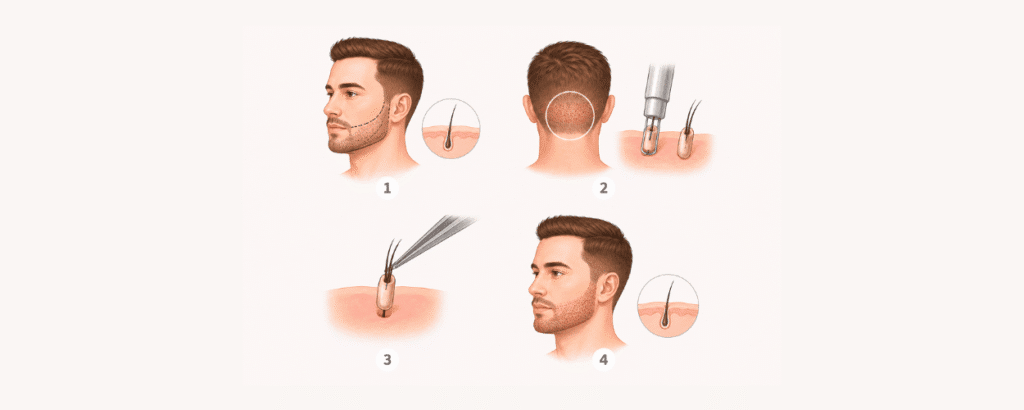
This curvature means that during FUE extraction, the micro-punch tool must follow the precise trajectory of each individual follicle beneath the scalp. If the angle of the punch deviates from the follicle path, it cuts through the follicle itself – a complication known as transection. A transected follicle is damaged and will not grow.
Transection rates are one of the key clinical metrics that separate experienced afro hair surgeons from those without specialist training. In the hands of a non-specialist, transection rates for afro hair can be significantly higher – meaning a lower proportion of viable grafts and a poorer overall result. At Capital Hair Restoration, our surgeons have refined their technique over thousands of procedures to achieve consistently low transection rates even in the most tightly coiled hair types.
Challenge 2: Follicular Unit Density and Spacing
Afro hair follicles tend to sit closer together beneath the scalp than straight hair follicles, with less predictable spacing between them. This increases the risk of inadvertently damaging adjacent follicles during extraction – particularly in a dense donor area where the curved paths of neighbouring follicles may overlap beneath the surface.
Managing donor area extraction in a way that maximises graft yield while minimising damage to surrounding follicles requires a systematic, methodical approach that only develops through significant experience with afro hair specifically.
Challenge 3: Punch Tool Selection
The micro-punch tools used for FUE extraction are available in a range of sizes and designs. For straight hair, a standard punch of 0.8 to 1.0mm is typically used. For afro hair, the tightly coiled follicular structure often requires a slightly larger punch – typically 1.0 to 1.2mm – to accommodate the curved path without transecting the follicle.
Clinics that use a one-size-fits-all approach to punch selection are not optimised for afro hair. The right tool, used correctly, makes a meaningful difference to graft survival and the overall yield of viable follicles from the donor area.
Challenge 4: Graft Fragility During Handling
Once extracted, afro hair grafts are more susceptible to desiccation (drying out) and physical damage during the handling and storage phase than straight hair grafts. The tightly coiled structure means the graft body is more compact, and any trauma during extraction or implantation has a disproportionate impact on viability.
Minimising the time grafts spend outside the body, using appropriate preservation solutions, and handling each graft with care during implantation are all practices that distinguish specialist clinics from those without deep experience in afro hair.
Challenge 5: Hairline Design for Afro Hair
Designing a natural afro hairline is a distinct skill set that goes beyond the technical aspects of extraction and implantation. A natural hairline for a Black man has specific aesthetic characteristics – a soft, slightly irregular front edge, appropriate temple framing, and a density distribution that creates a gradual, organic transition rather than a hard line.
Applying a generic hairline template – one designed with straight or European hair in mind – to an afro hair patient produces results that look artificial and incongruous with the surrounding hair. An experienced afro hair specialist understands the anatomy of a natural Black hairline and designs accordingly, taking the patient’s facial structure, age, and personal aesthetic preferences into account.
Challenge 6: Recipient Site Angle and Curl Direction
When creating the recipient sites – the tiny incisions into which grafts are implanted – the angle, depth, and direction of each incision must reflect the natural growth pattern of the patient’s hair. For afro hair, this means recreating the characteristic curl direction and growth angle at each site, which varies across different areas of the scalp.
If grafts are implanted at the wrong angle or without reference to the surrounding natural curl pattern, the transplanted hair will grow in a direction that is inconsistent with the rest of the scalp – creating a result that looks unnatural despite technically successful graft survival.
“The recipient site creation is where I would say the artistry of the procedure is most visible. You are effectively mapping out how every single hair is going to grow – its angle, its direction, its depth. For afro hair, where the curl pattern is so distinctive, getting this right is what separates a result that blends invisibly from one that looks obviously transplanted. It is painstaking work, but it is exactly what produces the natural outcomes our patients come to us for.”
— Steven Ambrose, Lead Consultant, Capital Hair Restoration
The Advantage: Why Afro Hair Can Deliver Outstanding Coverage
Alongside the challenges, afro hair has a significant structural advantage in transplantation: the natural coil and volume of each hair shaft means that a single graft covers considerably more visual surface area than a straight hair graft. This is sometimes described as the afro hair advantage – in experienced hands, it allows strong density and coverage to be achieved with a more conservative graft count than would be required for straight hair.
This advantage is only realised, however, when the surgeon understands how to place and orient the grafts to make best use of that natural volume. Misplaced grafts – even viable ones – do not deliver the coverage they are capable of.
What to Ask Your Clinic About These Challenges
Before committing to a clinic for your afro hair transplant, these are the questions that get to the heart of whether they have genuinely overcome these challenges:
- What is your typical transection rate for afro hair patients? A specialist will be able to answer this with confidence.
- What punch size and design do you use for tightly coiled hair? Look for a specific, considered answer.
- Can I see a portfolio of afro hair results? Results from patients with similar hair types are the most reliable evidence of capability.
- How do you approach hairline design for Black patients? The answer should demonstrate an understanding of the specific aesthetic of a natural afro hairline.
Your Next Step
At Capital Hair Restoration, overcoming the challenges of afro hair transplantation is something we have dedicated over twenty years to mastering. Book your free consultation at one of our clinics across the UK including Harley Street, London, Chelmsford, Cambridge, Guildford, Reading, Watford, Portsmouth, and Southampton.


Book Your Free Hair Transplant Consultation
Fill in your details and we'll get in touch with you shortly.