

Age and Beard Transplants
Age and Beard Transplants
Age and Beard Transplants: Is There an Ideal Time to Have One?
One of the most common questions men ask when considering a beard transplant is whether their age affects their suitability for the procedure. It is a question that comes from both ends of the spectrum. Younger men wonder whether they are old enough to proceed, while older men sometimes worry that they may have left it too late. The honest answer is that age is a relevant factor, but it is rarely the deciding one, and the picture is more nuanced than a simple age threshold would suggest.
This article looks at how age interacts with beard transplant candidacy, what the ideal timing considerations are, and why the right age for a beard transplant is ultimately an individual question rather than a universal one.
“One of the biggest mistakes a patient can make is assuming that patchy beard growth at 18 or 19 is permanent. Facial hair development often continues well into the twenties, which is why timing is such an important part of the consultation process.”
Darryl King, Hair Transplant Consultant, Capital Hair Restoration
Why Age Matters in Beard Transplantation
Age matters in beard transplantation for several reasons, and understanding them helps to frame why surgeons approach the question of timing the way they do.
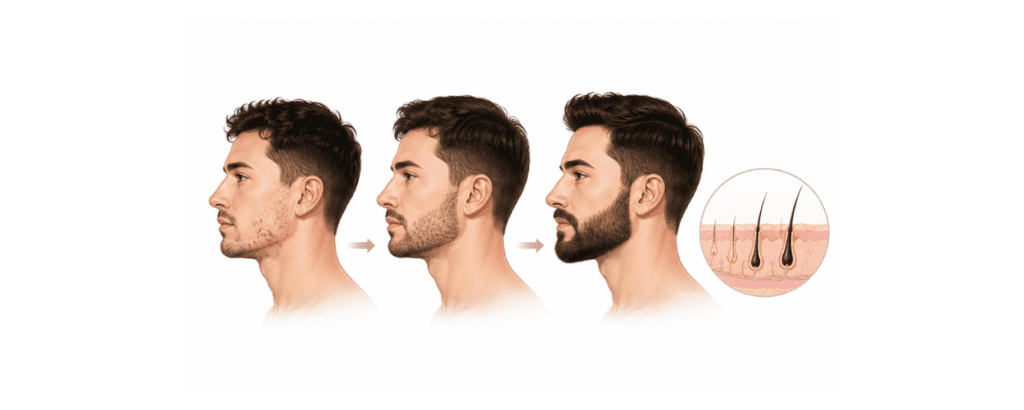
The primary concern at the younger end of the age range is the ongoing development of natural facial hair. For many men, facial hair continues to develop and change through the late teens and into the mid-twenties. A man who has sparse or patchy beard growth at nineteen may find that his natural coverage improves considerably over the following five or six years as his hormonal profile matures and his follicles respond to androgens over time.
If a beard transplant is performed before this natural development has completed, there is a risk that the surrounding natural hair continues to fill in after the procedure, potentially altering the overall appearance of the beard in ways that were not anticipated at the time of surgery. In less likely scenarios, the natural beard could develop in a way that creates an inconsistency between the transplanted areas and the areas that have grown naturally, requiring further intervention to address.
At the older end of the age range, the concern is different. Older men may have more advanced scalp hair loss, which can affect the availability and density of the donor area. If scalp hair loss is still progressing, there is a case for considering how best to allocate the available donor follicles across both scalp and facial restoration needs, if both are relevant. Beyond this, there is no meaningful upper age limit for a beard transplant. Men in their fifties, sixties, and beyond can be excellent candidates provided their donor area is adequate and their general health is good.
The relationship between age and beard transplant candidacy is therefore not a simple one. It is not a case of being too young or too old in any absolute sense. It is a case of being at the right point in your individual hair development journey, and this is something that can only be properly assessed through a thorough consultation with an experienced surgeon.
“There is no perfect age for a beard transplant. The best candidates are those whose beard development has stabilised, who have a suitable donor area, and who have realistic expectations about what can be achieved.”
Steven Ambrose, Hair Transplant Consultant, Capital Hair Restoration
Beard Transplants in Your Teens and Early Twenties
For men in their teens or very early twenties who are frustrated with their beard growth, the temptation to seek a transplant as soon as possible is understandable. When you have wanted a beard for years and it simply will not grow, waiting feels like an unnecessary delay. However, the advice from experienced surgeons is consistent on this point: for most men, the mid-twenties is the earliest appropriate time to consider a beard transplant, and there are good reasons for this.
The teenage years and early twenties are a period of significant hormonal change. Testosterone and DHT levels are still establishing themselves, and the follicles in the beard area are still responding to these hormonal signals. For many men, beard growth that appears sparse or absent at eighteen or nineteen continues to develop meaningfully through the early to mid-twenties. Operating on a beard that has not yet finished developing means making permanent decisions based on an incomplete picture.
There are exceptions to this. Some men reach their mid-twenties or even their late twenties with no meaningful improvement in their facial hair, and for these patients the case for earlier intervention becomes stronger. But even in these cases, a thorough assessment and an honest conversation about timing is essential before any procedure is planned.
It is also worth noting that most reputable clinics in the UK will not perform beard transplants on patients under the age of eighteen, regardless of the circumstances. This is both a clinical and an ethical position, and it reflects the importance of ensuring that patients are making informed, considered decisions about permanent procedures.

Beard Transplants in Your Mid to Late Twenties
The mid to late twenties is generally considered the sweet spot for beard transplant candidacy in terms of age. By this point, the natural development of facial hair is typically complete or very close to complete, which means the surgeon has a stable picture of the patient’s natural beard pattern to work with. The donor area is also typically at or near its peak density at this stage of life, meaning there is good availability of follicles for transplantation.
Men in their mid to late twenties who have persistent patchy growth, an inability to grow a full beard, or facial scarring that affects their beard are well-placed for a transplant procedure. The results achieved at this age tend to be highly predictable, and the donor area is generally in good condition to provide the grafts needed.
One consideration for men in this age group is the long-term trajectory of their scalp hair. If there is a family history of significant male pattern baldness, it is worth having a conversation with your surgeon about how to plan your donor usage in a way that accounts for potential future scalp hair loss as well as your current beard restoration goals. Careful planning at this stage can help to ensure that your long-term interests are protected.
Beard Transplants in Your Thirties and Forties
For men in their thirties and forties, the timing question looks quite different from those in their twenties. By this stage, facial hair development is long complete, and the natural beard pattern is well established. This means the surgeon has a very clear and stable picture to work with, and the results of a beard transplant in this age group tend to be highly predictable.
Men in their thirties are often in an excellent position for a beard transplant. The donor area is typically still in good condition, scalp hair loss patterns are becoming clearer, and the patient has usually had enough time to be certain that their beard growth issues are not going to resolve on their own. Many of the most successful beard transplant results are achieved in patients in this age group.
For men in their forties, the key consideration shifts slightly towards the donor area. By the mid-forties, scalp hair loss may be more advanced for some men, which can affect the number of follicles available for transplantation. If significant scalp hair restoration is also a goal, the available donor supply needs to be carefully planned to ensure that both objectives can be met to a satisfactory standard. This is a conversation that your surgeon will initiate as part of the consultation process, and it is one that requires honest and open discussion about your priorities.
Beyond this, there is nothing about being in your thirties or forties that makes a beard transplant less appropriate or less likely to succeed. General health, donor density, and realistic expectations remain the primary factors, and age within this range is rarely a limiting one.
“We regularly see excellent beard transplant results in men in their thirties, forties, fifties, and beyond. Suitability is determined far more by donor hair quality and individual circumstances than by age alone.”
Darryl King, Hair Transplant Consultant, Capital Hair Restoration
Beard Transplants in Your Fifties and Beyond
One of the most persistent misconceptions about beard transplants is that they are primarily a procedure for younger men. This is not the case. Men in their fifties, sixties, and beyond can be perfectly good candidates for a beard transplant, and the procedure can be just as effective and just as transformative at this stage of life as it is for younger patients.
The main considerations for older patients are the same as for any age group, but with a slightly different weighting. The donor area needs to be assessed carefully, as scalp hair loss may be more advanced and the overall density of the donor zone may be lower than in a younger patient. General health is also a factor, as with any surgical procedure, and any medications being taken that could affect healing or graft survival need to be disclosed and reviewed at consultation.
One advantage that older patients often bring to the process is clarity of expectation. Men who have lived with beard growth issues for decades tend to have a very clear and grounded sense of what they want from a procedure, and they approach the consultation with a realism that makes the planning process straightforward. This is genuinely valuable, and it is one of the reasons why outcomes in older patients are often excellent.
The bottom line is that there is no age at which a beard transplant becomes automatically inappropriate. If your donor area is adequate, your health is good, and your expectations are realistic, age alone is not a barrier.

Age and Beard Transplants: Is There an Ideal Time to Have One?
What Is the Ideal Age for a Beard Transplant?
If there is an ideal age range for a beard transplant, it is broadly the mid-twenties to mid-forties. Within this window, facial hair development is typically complete, the donor area is generally at its strongest, and the patient has had enough time and life experience to approach the decision with the clarity and realism that a permanent procedure deserves.
That said, ideal is a relative term. Men outside this range, both younger and older, can and do achieve excellent results. The mid-twenties to mid-forties window is not a rule. It is simply the range within which the most straightforward cases tend to fall, with the fewest complicating factors around timing, donor supply, and natural hair development.
What matters more than age, in every case, is the individual picture. A 22-year-old with a fully established beard pattern, a healthy donor area, and stable facial hair growth may be a better candidate than a 28-year-old whose natural beard is still developing. A 55-year-old with excellent donor density and good general health may be a better candidate than a 35-year-old with limited donor supply. Age is one input into the assessment, not the determining factor.
Final Thoughts
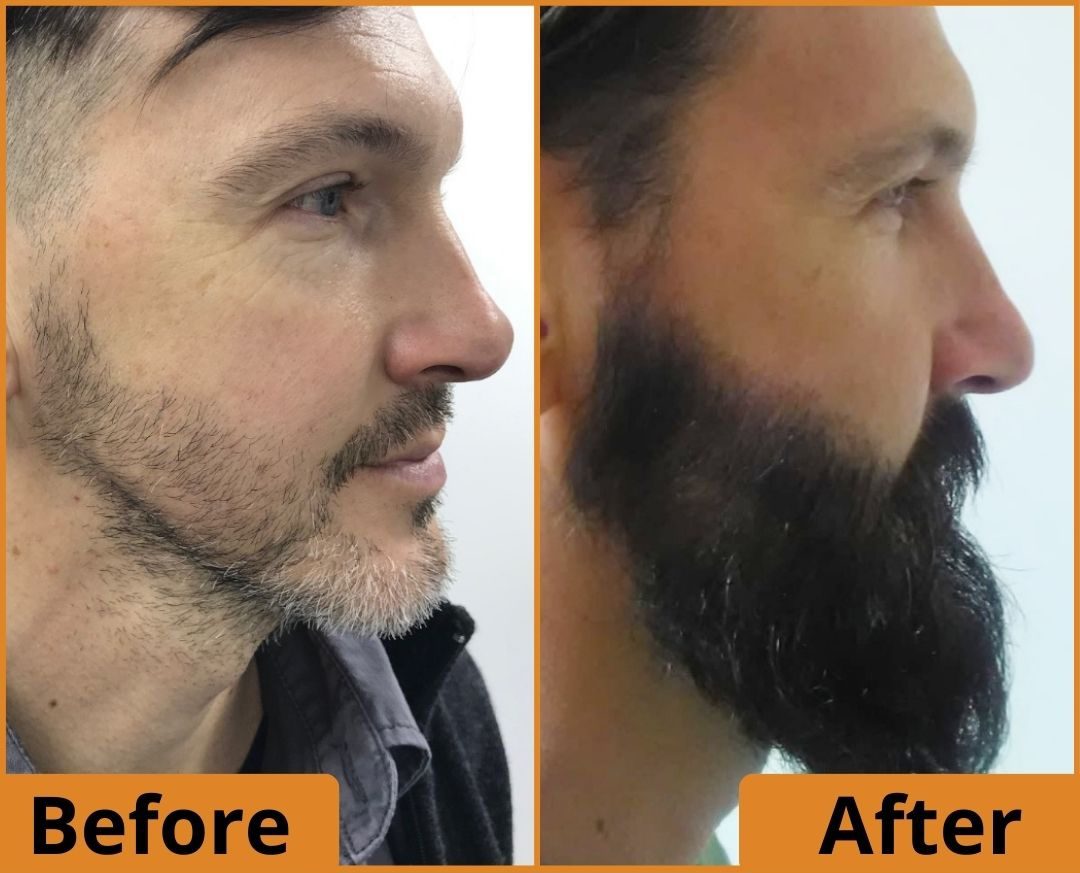
When it comes to beard transplants, age is an important consideration, but it is rarely the deciding factor. What matters most is whether your facial hair development has stabilised, whether your donor area can support the procedure, and whether your expectations align with what can realistically be achieved.
For younger men, patience can often be the best decision. Facial hair frequently continues to develop well into the twenties, and allowing that process to complete naturally ensures that any future procedure is based on a full and accurate picture of your beard growth. For older men, concerns about having missed the opportunity are usually unfounded. As long as the donor area remains suitable and overall health is good, excellent beard transplant results can be achieved at virtually any age.
Ultimately, there is no universal “perfect age” for a beard transplant. The right time is when your individual circumstances, goals, and donor characteristics come together to make the procedure both appropriate and worthwhile. That assessment can only be made through a detailed consultation with an experienced hair transplant specialist.
If you are considering a beard transplant, Capital Hair Restoration offers consultations across the UK, including London, Portsmouth, Reading, Watford, Cambridge, Chelmsford, Southampton and Guildford.
At Capital Hair Restoration, consultations focus on beard development, donor area assessment, long-term planning, graft requirements, and realistic expectations. Our experienced team will provide an honest assessment of your suitability and help you determine whether now is the right time to proceed.
Book your consultation today and take the first step towards achieving the beard you’ve always wanted.


Book Your Free Hair Transplant Consultation
Fill in your details and we'll get in touch with you shortly.