


Beard Transplants for Alopecia: What You Need to Know
Beard Transplants for Alopecia: What You Need to Know
Beard Transplants for Alopecia: What You Need to Know
Alopecia is one of the more complex reasons men seek beard transplants, and it is also one of the areas where clear, honest information is hardest to find. If you have alopecia affecting your beard area and are wondering whether a transplant is a realistic option for you, the answer is that it may well be, but it depends on a number of important factors that need to be carefully assessed before any decision is made.
This article explains the different forms of alopecia that can affect facial hair, how they interact with the beard transplant process, and what you need to know before considering surgery as a route to restoring your beard.
“The most important question for alopecia patients is not whether a beard transplant is possible, but whether the condition is stable enough for transplantation to give a lasting result.”
Darryl King, Hair Transplant Consultant
Understanding Alopecia and Its Different Forms
Alopecia is not a single condition. It is a broad term used to describe hair loss, and it encompasses several distinct conditions with different causes, patterns, and implications for treatment.
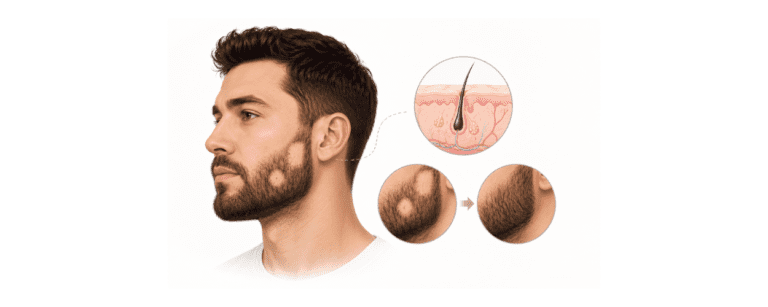
Alopecia areata is the most common form relevant to beard transplants. It is an autoimmune condition in which the body’s immune system mistakenly attacks hair follicles, causing them to stop producing hair. In many cases, the follicles themselves are not permanently destroyed. They enter a dormant state, which means hair regrowth is possible, either spontaneously or with treatment. Alopecia areata typically presents as patchy hair loss, and when it affects the beard area it can cause one or more clearly defined bald patches within an otherwise normal beard.
Alopecia barbae is a specific form of alopecia areata that affects the beard area in particular. It presents as circular or oval patches of hair loss within the beard, and can vary in severity from a single small patch to extensive loss across the entire beard area. Like alopecia areata more broadly, alopecia barbae is driven by autoimmune activity, and its course is unpredictable. Some patients experience spontaneous regrowth, while others find the condition persists or progresses over time.
Alopecia totalis and alopecia universalis are more severe forms of the condition. Alopecia totalis involves complete loss of scalp hair, while alopecia universalis involves complete loss of all body hair, including facial hair. These conditions present particular challenges for beard transplantation, both because of the extent of the hair loss and because the autoimmune activity that drives them may affect the donor area as well as the recipient site.
Androgenetic alopecia, more commonly known as male pattern baldness, primarily affects the scalp rather than the beard, though it can in some cases contribute to changes in facial hair density over time. This form of hair loss is driven by genetics and hormones rather than autoimmune activity, and its implications for beard transplantation are different from those of alopecia areata and its variants.
Understanding which form of alopecia you have is the essential starting point for any conversation about beard transplantation, and it is something that will be assessed carefully at consultation.
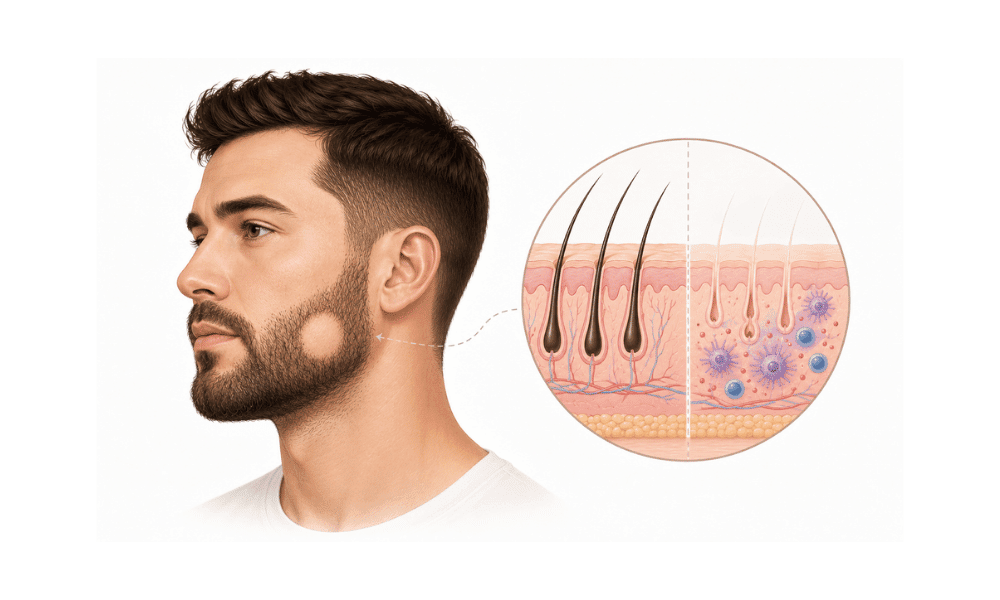
Can You Have a Beard Transplant with Alopecia Areata?
The short answer is that it may be possible, but only under specific conditions. The most important of these is that the alopecia must be stable. This means the condition has not been actively progressing for a significant period of time, typically at least one to two years, before surgery is considered.
The reason stability is so important is straightforward. If the autoimmune activity that drives alopecia areata is still ongoing at the time of transplantation, the same process that caused the original hair loss could attack the newly transplanted follicles. This would not only compromise the result of the procedure but could represent a significant waste of donor hair that cannot be replaced. Performing a beard transplant into an active alopecia environment is a risk that responsible surgeons will not take.
Stability does not mean that the alopecia has been completely resolved or that regrowth has occurred in all affected areas. It means that the condition has settled to a point where new patches are not forming and existing patches are not enlarging. This is assessed through a combination of your medical history, a physical examination, and in some cases a referral back to a dermatologist for confirmation before surgery is planned.
It is also worth noting that even in patients whose alopecia is stable, the response of transplanted follicles can be less predictable than in patients without an autoimmune history. Graft survival rates may be somewhat lower, and there is a possibility that the condition could reactivate in the future, potentially affecting the transplanted hair as well as any remaining natural growth. These are honest realities that need to be part of any informed consent conversation before a patient with alopecia proceeds with a beard transplant.
None of this means a beard transplant is off the table for alopecia patients. Many men with a history of alopecia areata have undergone successful beard transplants and achieved excellent, lasting results. It simply means that the assessment process is more thorough, the risks are higher, and the conversation about expectations needs to be more detailed.
The Importance of Dermatological Assessment
For men with alopecia considering a beard transplant, a dermatological assessment is an important part of the process. A dermatologist can confirm the type and current activity level of the condition, advise on any treatments that may help to stabilise it further before surgery, and provide an informed view on the likely long-term course of the condition.
At Capital Hair Restoration, we work closely with our patients to ensure that any underlying conditions are properly understood and managed before surgery is considered. Where we feel a dermatological opinion would add value to the assessment process, we will say so clearly. Our priority is always to give you the best possible chance of a successful, lasting outcome, and that sometimes means taking a more cautious approach to timing than a patient might initially hope for.
If you have been told by another clinic that your alopecia is not a barrier to immediate treatment without any further assessment, we would encourage you to seek a second opinion before proceeding.
Alopecia Totalis and Alopecia Universalis: Special Considerations
For men with alopecia totalis or alopecia universalis, the situation is more complex than for those with alopecia areata affecting only the beard area. In these conditions, hair loss is extensive and the autoimmune activity that drives it tends to be more severe and less predictable in its course.
The primary challenge with alopecia totalis in the context of a beard transplant is the donor area. Because alopecia totalis involves complete loss of scalp hair, the usual donor site is unavailable. This means that if transplantation is to be considered at all, alternative donor sources such as body hair from the chest, arms, or legs would need to be assessed. Body hair can be used for beard transplantation in some cases, but it has different characteristics to scalp hair and the results can be less predictable in terms of texture, growth rate, and longevity.
For alopecia universalis, where all body hair is absent, transplantation is not currently a viable option as there is no donor source available from which to harvest grafts.
It is also worth noting that the autoimmune activity associated with alopecia totalis and universalis tends to be more aggressive and less stable than in localised alopecia areata. The risk of the condition reactivating and affecting transplanted follicles is higher, and the unpredictability of the condition makes it very difficult to give reliable assurances about long-term outcomes.
For men in this situation, an honest conversation about what is and is not achievable is essential. At Capital Hair Restoration, we will never raise false hope or recommend a procedure that we do not believe is in your best interests. If transplantation is not appropriate in your case, we will tell you clearly and help you understand what alternatives, if any, may be available to you.
“A beard transplant can be highly effective for patients with stable alopecia areata, but success begins with honest assessment, careful planning, and realistic expectations about the long-term nature of the condition.”
Steven Ambrose, Hair Transplant Consultant
Non-Surgical Options for Alopecia Beard Loss
For men with alopecia affecting the beard who are not suitable candidates for transplantation, or who are not yet at a point where surgery is appropriate, non-surgical options are worth understanding.
Medical treatments for alopecia areata include topical corticosteroids, intralesional steroid injections, and immunotherapy. These treatments aim to suppress the autoimmune activity and encourage the dormant follicles to resume hair production. They do not work for all patients, and results can be variable, but for some men they can produce meaningful regrowth in affected areas without the need for surgery.
Minoxidil applied topically to the beard area is also used by some patients with alopecia barbae, though its effectiveness in this context is more limited than in straightforward genetic beard thinning. It is not a treatment for the underlying autoimmune condition and will not address the root cause of the hair loss.
PRP therapy, which involves injecting concentrations of the patient’s own platelet-rich plasma into the affected area, has shown some promise in stimulating hair regrowth in alopecia areata patients in clinical studies. It is not a guaranteed treatment, but it may be worth discussing as part of a broader management plan, particularly for patients who are working towards achieving the stability needed for a transplant to be considered.
What Does the Transplant Process Look Like for Alopecia Patients?
For men with alopecia who are confirmed as suitable candidates for a beard transplant, the procedure itself follows the same fundamental process as for any other patient. The key differences lie in the pre-procedure assessment, the surgical planning, and the level of monitoring during recovery.
The pre-procedure assessment for an alopecia patient is more detailed than for a patient without an autoimmune history. In addition to the standard evaluation of the donor area and the beard area, your surgeon will want a clear picture of the history and behaviour of your condition, including how long it has been stable, whether you have had any previous treatments, and whether there are any ongoing dermatological management plans in place. This information shapes both the surgical planning and the advice given about realistic outcomes.
The surgical planning for an alopecia beard transplant requires particular care around graft placement. In cases where alopecia areata has caused patchy loss within an existing beard, the surgeon needs to work carefully around any existing natural hair that may still be present, placing grafts to fill the affected areas while maintaining a natural overall appearance. In cases of more extensive loss, the planning process is closer to that of a full beard transplant from scratch, as discussed in the previous article in this series.
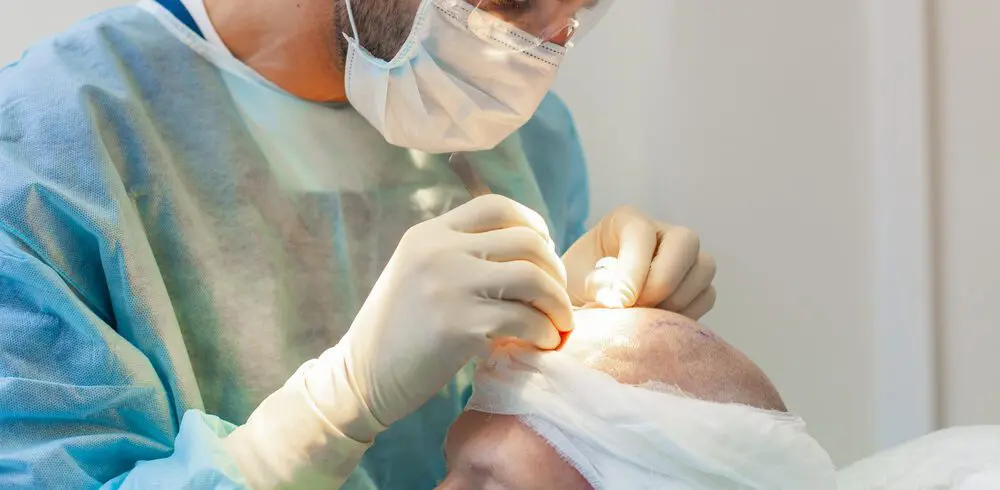
The procedure is carried out under local anaesthetic using FUE technique, with the same precision of graft placement that applies to all beard transplants at Capital Hair Restoration. The duration of the procedure depends on the number of grafts being placed and the complexity of the case.
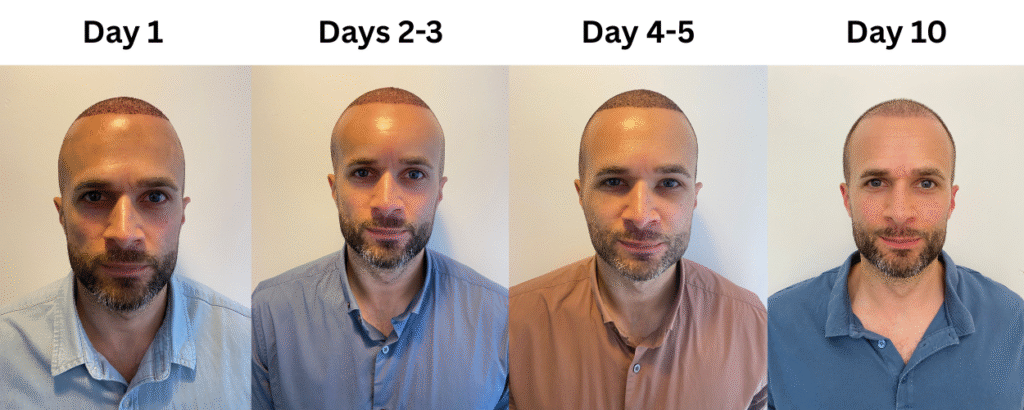
Recovery for alopecia patients follows the same general pattern as for other beard transplant patients, with the transplanted hairs shedding in the first few weeks before new growth begins from around three to four months. The key difference is the level of vigilance required during the recovery period. Patients with an alopecia history are monitored more closely for any signs that the condition may be reactivating, and any concerns that arise during recovery are addressed promptly.
Managing Expectations for Alopecia Beard Transplants
Honest expectation management is important for all beard transplant patients, but it is particularly critical for those with alopecia. There are two areas where expectations need to be especially carefully managed.
The first is graft survival. In patients with an autoimmune history, graft survival rates can be somewhat lower than in patients without alopecia. This does not mean the procedure will fail, but it does mean that the density achieved may be slightly less predictable, and that the final result needs to be evaluated at the full twelve-month mark before any conclusions are drawn about whether further treatment is needed.
The second is long-term stability. Even a successful beard transplant in an alopecia patient does not guarantee that the condition will not reactivate in the future. If it does, the transplanted hair may be affected just as natural hair can be. This is an honest reality that every alopecia patient considering a beard transplant needs to understand and accept before proceeding.
None of this should be taken as a reason to abandon the idea of a beard transplant if you have alopecia. Many patients achieve excellent and lasting results. It is simply a case of going into the process with clear eyes and a full understanding of the additional variables involved.
“Responsible beard restoration is about knowing when to proceed and when to wait. For patients with alopecia, taking the time to properly assess the condition often makes the difference between a good result and a great one.”
Darryl King, Hair Transplant Consultant
Questions to Ask at Your Consultation if You Have Alopecia
Going into a consultation with alopecia requires a slightly different set of questions than for a patient without an autoimmune history. The following are worth raising to make sure you get the most out of your assessment:
- How long does my condition need to have been stable before surgery is appropriate?
- Do you recommend a dermatological assessment before we proceed?
- How does my alopecia history affect the likely graft survival rate?
- What is the risk of the condition reactivating after the transplant?
- If the condition does reactivate, what options would be available to me?
- Are there any non-surgical treatments you would recommend either before or alongside a transplant?
- What does the monitoring and aftercare process look like for a patient with my history?
A surgeon who answers these questions clearly, and without rushing is one you can trust to have your best interests at heart.

Is a Beard Transplant Right for You if You Have Alopecia?
If you have alopecia affecting your beard and have been wondering whether a transplant is a realistic option, the answer depends on the type and current status of your condition, the health of your donor area, and your willingness to approach the process with realistic expectations about the additional variables involved.
For patients with stable alopecia areata or alopecia barbae and a healthy donor area, a beard transplant is a genuine option that has produced excellent results for many men. For patients with more extensive or less stable forms of the condition, a more cautious approach is needed, and surgery may not be the right answer at this point in time.
The only way to know with certainty where you stand is to have a thorough assessment with an experienced surgeon who takes the time to understand your individual situation fully.
Book a Beard Transplant Consultation
Alopecia adds an extra layer of complexity to beard transplantation, but it does not automatically rule it out. For many patients with stable alopecia areata or alopecia barbae, a beard transplant can provide a meaningful and long-lasting improvement in facial hair density, helping to restore both beard coverage and confidence.
The key factor is stability. Before any transplant is considered, it is essential to understand the type of alopecia involved, whether the condition is still active, and how likely it is to remain stable in the future. Taking the time to assess these factors properly helps protect your donor hair, improve the chances of a successful outcome, and ensure that any treatment is built on realistic expectations.
It is also important to remember that a beard transplant is only one potential option. In some cases, medical treatments, dermatological management, or simply allowing more time for the condition to stabilise may be the most appropriate next step. The goal should always be to make the right decision for your long-term interests, rather than rushing into surgery before the circumstances are right.
If you are considering a beard transplant and have a history of alopecia, Capital Hair Restoration offers consultations across the UK, including London, Portsmouth, Reading, Watford, Cambridge, Chelmsford, Southampton and Guildford.
At Capital Hair Restoration, consultations focus on assessing the type and stability of your alopecia, evaluating donor hair availability, discussing treatment options, and providing honest guidance on whether a beard transplant is appropriate for your individual circumstances. Our experienced team will help you understand the opportunities, limitations, and long-term considerations involved before you make any decisions.
Book your consultation today and take the first step towards understanding your beard restoration options.


Book Your Free Hair Transplant Consultation
Fill in your details and we'll get in touch with you shortly.