



Can You Have a Beard Transplant with Patchy Facial Hair?
Can You Have a Beard Transplant with Patchy Facial Hair?

Can You Have a Beard Transplant with Patchy Facial Hair?
Patchy beard growth is one of the most common reasons men enquire about beard transplants. For many, it is not a case of having no facial hair at all. It is the frustration of having some growth but not enough, with noticeable gaps that prevent a consistent, well-defined beard from developing. If this sounds familiar, you are far from alone, and the good news is that a beard transplant can be a highly effective solution for exactly this situation.
This article explains how beard transplants work for men with patchy facial hair, what results are achievable, and what the process involves from consultation through to the final outcome.
“Patchy beard growth is usually not a question of effort or grooming. In most cases, it comes down to follicle distribution, and a beard transplant allows us to place hair precisely where nature left gaps.”
Darryl King, Hair Transplant Consultant
Why Does Patchy Beard Growth Happen?
Before looking at how a beard transplant addresses patchy growth, it helps to understand why patchiness occurs in the first place. The most common cause is genetics. Facial hair follicle distribution is largely determined by your DNA, and if your natural follicle density is low or unevenly distributed across the face, no amount of time or grooming will change that. Some men simply have fewer active follicles in certain areas of the face, leading to thin or absent growth in those zones regardless of how well they look after their skin or how long they wait for the beard to fill in.
Other causes of patchy beard growth include scarring from acne, surgery, or injury, which can permanently damage follicles in affected areas. Conditions such as alopecia areata can also cause patchy loss, though treatment in these cases requires a more careful approach that accounts for the underlying condition.
In all of these scenarios, the root issue is the same. The follicles needed to produce hair in certain areas are either absent, damaged, or inactive. A beard transplant addresses this by introducing new, healthy follicles directly into the areas where growth is lacking.
How Does a Beard Transplant Address Patchy Growth?
The key advantage of a beard transplant for patchy growth is precision. Unlike some cosmetic procedures that treat a broad area, a beard transplant allows your surgeon to place grafts exactly where they are needed. If your growth is strong on the chin and jawline but thin across the cheeks, grafts can be targeted specifically at the cheek area. If the patchiness is concentrated in one or two defined gaps within an otherwise reasonable beard, those gaps can be addressed without touching the surrounding areas.
This targeted approach means that a beard transplant for patchy growth does not have to be a large-scale procedure. Many patients with patchy rather than absent beards require a relatively modest number of grafts compared to those starting from nothing, which typically means a shorter procedure time and a more contained recovery.
The technique used for patchy beard restoration is the same as for full beard transplants, Follicular Unit Extraction, or FUE. Individual follicular units are extracted from the donor area, most commonly the back or sides of the scalp, and implanted into the recipient sites on the face with precise control over angle, direction, and depth.

beard transplant
Which Areas Are Most Commonly Affected by Patchiness?
Patchy beard growth tends to follow recognisable patterns, and certain areas of the face are more commonly affected than others. Understanding where your patchiness falls helps to frame what a transplant can achieve and how many grafts are likely to be needed.
The cheeks are the most frequently treated area in patchy beard transplants. Many men can grow reasonable coverage on the chin, jawline, and upper lip but struggle with thin or absent growth across the cheekbones and upper cheek area. This is one of the most noticeable forms of patchiness because the gap between the moustache and sideburn area is clearly visible, making it difficult to style the beard in a way that disguises the issue effectively.
The chin and goatee area is another common problem zone. Some men have reasonable growth higher on the face but find that the chin itself, or the area immediately around it, is thin or uneven. Targeted grafting in this area can define and fill the goatee zone for a cleaner, more structured result.
The jawline and neck transition area can also be affected, with some men finding that their beard grows well on the face itself but thins out or becomes patchy as it approaches the jaw and neck. Careful placement of grafts in this zone can create a more defined lower border to the beard.
Sideburns are a less commonly discussed but equally valid area for targeted transplantation. Men who have reasonable facial hair but limited sideburn coverage can use a beard transplant to extend and define the sideburn area, creating a more connected and consistent overall appearance.
How Many Grafts Are Needed for a Patchy Beard Transplant?
One of the most common questions patients ask is how many grafts they will need. For patchy beard restoration, the answer depends on the size of the areas being treated, the degree of patchiness in those zones, and the density the patient wants to achieve.
As a general guide, treating a specific patchy area such as the cheeks typically requires fewer grafts than a full beard restoration. A patient looking to fill in moderate patchiness across both cheeks might require somewhere in the range of 500 to 1,500 grafts, while more extensive patchiness or a desire for higher density may push this figure higher.
It is important to understand that these are broad estimates. The precise number of grafts needed for your individual case can only be determined following a proper assessment of your facial hair, your skin, and your donor area. Your surgeon will give you a specific figure at consultation based on your actual situation rather than a general range.
What can be said with confidence is that patchy beard transplants tend to use fewer grafts than full beard restorations, and this is generally reflected in a shorter procedure time and a more straightforward recovery.
“One of the biggest advantages of treating a patchy beard is precision. We are not creating an entirely new beard. We are enhancing what is already there and helping it look fuller, stronger, and more balanced.”
Steven Ambrose, Hair Transplant Consultant
Will the Result Look Natural on a Patchy Beard?
One of the most important questions for men considering a patchy beard transplant is whether the transplanted hair will blend seamlessly with the existing growth. This is a completely valid concern, and the answer largely comes down to the skill and experience of the surgeon performing the procedure.
When grafts are placed into a patchy area that already has some existing hair growth, the surgeon must work carefully to match the angle, direction, and spacing of the transplanted hairs to the surrounding natural growth. Getting this right is what separates a result that looks completely natural from one that appears inconsistent or uneven. An experienced surgeon will study the growth patterns of your existing facial hair in detail before placing a single graft, using the surrounding hair as a guide for every placement decision.
The texture and calibre of the transplanted hair is also a consideration. Donor hair from the scalp is generally a good match for facial use, but your surgeon will assess whether the characteristics of your donor hair are well-suited to the areas being treated. In most cases, the result is a seamless blend between the transplanted and existing hair that is entirely undetectable once the new growth has matured.
It is also worth noting that the transplanted hair will initially shed after the procedure before regrowing. During this period, your existing natural beard hair will remain in place, which means you will not be left without coverage while waiting for the new growth to come through.
“The best patchy beard transplants are the ones nobody notices. When the angle, direction, and density are planned correctly, the transplanted hair blends seamlessly with the existing beard and simply looks natural.”
Darryl King, Hair Transplant Consultant
What Does Recovery Look Like for a Patchy Beard Transplant?
Recovery from a patchy beard transplant follows the same general pattern as recovery from a full beard transplant, though the experience is often more manageable given the smaller treatment area involved.
In the first few days after the procedure, you can expect some redness and minor swelling in the treated areas. Small scabs will form around each graft site, and it is important not to pick or disturb these as they heal. Most patients find that the visible signs of the procedure have settled significantly within the first week to ten days.
The transplanted hairs will shed from around two to four weeks post-procedure. This is a normal part of the process and does not indicate a problem. The follicles themselves remain intact beneath the skin and will begin producing new hair growth from around three to four months.
During the recovery period, you will be advised to avoid certain activities that could affect the healing process, including intense exercise, swimming, and direct sun exposure to the treated area. Your surgeon will provide you with a detailed set of aftercare instructions tailored to your specific procedure, and our team will be available to answer any questions that arise during your recovery.
By the time the new growth has fully matured at around the twelve-month mark, the result should be a beard that is even, natural, and exactly what you were hoping for.
Are There Any Alternatives to a Beard Transplant for Patchy Growth?
Before committing to a surgical procedure, it is worth understanding what non-surgical options exist for patchy beard growth and where their limitations lie. This is something a good surgeon will discuss with you honestly at consultation, rather than simply recommending surgery as the first and only option.
Minoxidil, applied topically to the face, is sometimes used to stimulate beard growth in men with patchy coverage. It can produce modest improvements in some patients, particularly those with naturally sparse but otherwise active follicles. However, it requires ongoing daily use to maintain any benefit, and results tend to be limited in areas where follicles are genuinely absent rather than merely inactive. It is not a substitute for transplantation in cases of significant patchiness.
Micro-needling and PRP therapy are also used in some clinics as non-surgical approaches to stimulating facial hair growth. These treatments work by encouraging the body’s natural regenerative processes and may be suitable as complementary treatments or for patients with very mild patchiness. Again, they cannot create growth in areas where no follicles exist.
For men whose patchiness is mild and whose follicles are simply underperforming rather than absent, a period of non-surgical treatment may be worth exploring first. For those with more pronounced gaps or areas of genuinely absent growth, surgery is likely to be the only approach that delivers a meaningful and lasting result.
At Capital Hair Restoration, we will always give you an honest view of all available options, including non-surgical ones, before recommending a course of action. Our goal is to help you make the right decision for your individual situation, not to steer you towards surgery when another approach may serve you better.
Is a Beard Transplant Right for You?
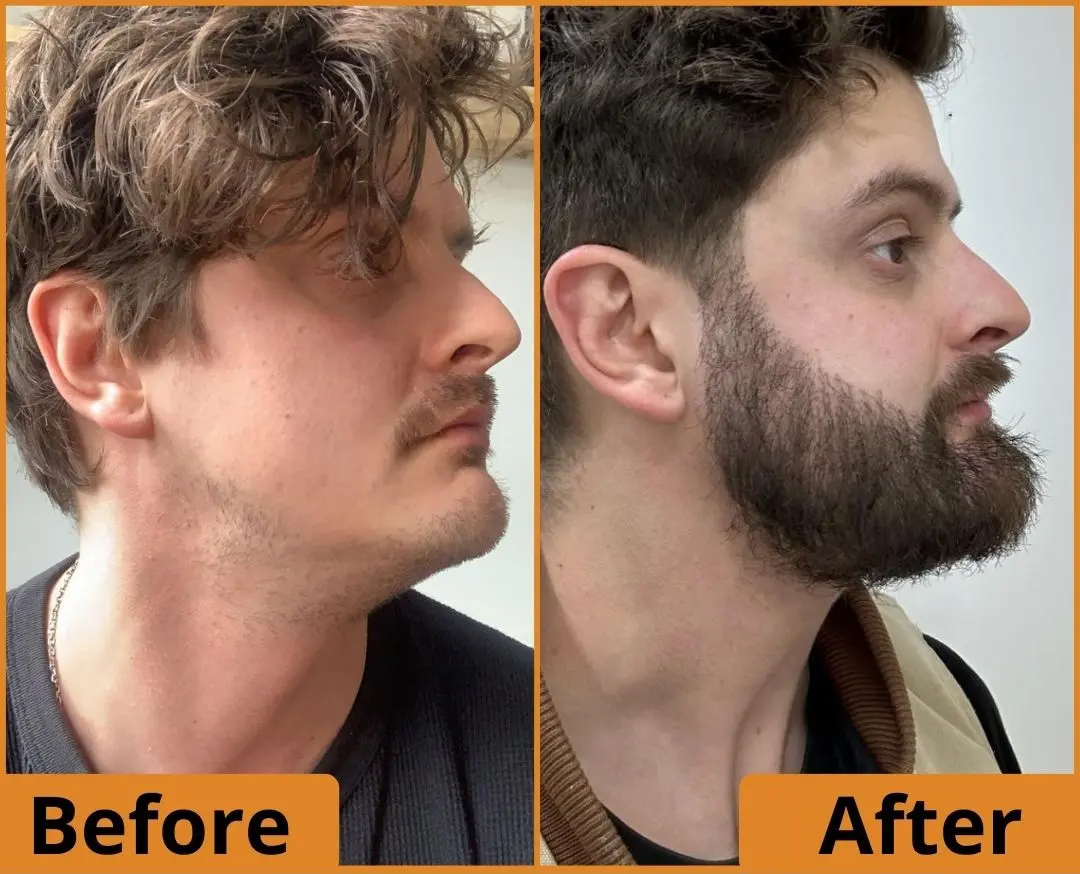
Patchy beard growth is incredibly common, and for many men it has little to do with grooming habits, skincare routines, or patience. In most cases, the underlying issue is simply follicle distribution. If the follicles are not present in certain areas, the beard will never fully connect or develop the density needed to create the look you want.
The good news is that patchy growth is often one of the most rewarding indications for a beard transplant. Rather than creating an entirely new beard, the procedure enhances and strengthens what is already there, filling gaps, improving symmetry, and creating a more balanced appearance. Because grafts can be placed with exceptional precision, even relatively small procedures can make a significant difference to the overall look of the beard.
The key is understanding what is achievable in your specific case. The size of the patchy areas, the density of your existing beard, and the quality of your donor hair all influence the final result. A personalised assessment allows these factors to be evaluated properly and ensures that the treatment plan is tailored to your goals.
If you are considering a beard transplant for patchy facial hair, Capital Hair Restoration offers consultations across the UK, including London, Portsmouth, Reading, Watford, Cambridge, Chelmsford, Southampton and Guildford.
At Capital Hair Restoration, consultations focus on beard density, follicle distribution, donor area assessment, graft planning, and long-term natural results. Our experienced team will explain exactly what can be achieved in your case and create a personalised treatment plan designed to enhance your existing beard while maintaining a natural appearance.
Book your consultation today and take the first step towards a fuller, more even beard.


Book Your Free Hair Transplant Consultation
Fill in your details and we'll get in touch with you shortly.