


Crown Hair Transplant Results: Before and After
Crown Hair Transplant Results: Before and After

Crown Hair Transplant Results: Before and After
If you are experiencing thinning or hair loss at the crown, you may be wondering: how effective is a crown hair transplant, and what results can you expect?
A crown hair transplant focuses on restoring hair in the vertex area, the circular region at the back of the scalp. This area is often one of the most challenging to treat due to its unique growth pattern and structure.
While crown transplants can deliver excellent results, they require careful planning, realistic expectations, and precise technique.
Understanding what crown hair transplant results look like before and after treatment is essential if you are considering this procedure.
Why the Crown Area Is Different
The crown is not the same as the hairline or frontal scalp.
One of the key reasons is the natural spiral growth pattern, often referred to as the crown swirl.
This means that:
- Hair grows in multiple directions
- Density needs to be distributed evenly in a circular pattern
- The visual appearance of coverage depends heavily on technique
In addition, the crown typically:
- Requires more grafts to achieve visible density
- Has a different blood supply compared to the front of the scalp
- Can take longer to show full results
Because of these factors, crown hair transplants are often considered more complex than hairline procedures.
Before and After: What to Expect
When reviewing crown hair transplant before and after results, it is important to understand that the improvement is often gradual and progressive.
Before the Procedure
Patients considering crown treatment typically experience:
- Visible thinning at the back of the scalp
- A circular bald spot or diffuse thinning
- Increased scalp visibility under light
In many cases, the crown may appear larger over time as hair loss progresses.
After the Procedure (Early Stage)
Immediately after surgery:
- The transplanted area will appear red
- Small scabs will form around each graft
- The crown pattern will be visible but not yet dense
Within the first few weeks, the transplanted hairs will shed. This is a normal part of the process and does not reflect the final result.
What Makes Crown Results Look Natural?
Achieving natural crown results is not just about adding hair.
It requires:
- Recreating the natural swirl pattern
- Placing grafts at the correct angle and direction
- Distributing density evenly across the area
A well-executed crown transplant should blend seamlessly with the surrounding hair, creating a natural and balanced appearance.
Crown Hair Transplant Results Timeline
Understanding the timeline is especially important when assessing crown hair transplant results.
Compared to the hairline, the crown often takes longer to show full results, which can affect expectations if you are not prepared.
Weeks 1–2: Healing Phase
In the first couple of weeks:
- Small scabs form around each graft
- Redness and mild sensitivity are common
- The grafts begin to settle into the scalp
At this stage, the crown will not yet appear fuller, as healing is the priority.
Weeks 2–4: Shedding Phase
During this phase:
- The transplanted hairs begin to fall out
- The follicles remain intact beneath the skin
- The scalp continues to recover
This shedding process is completely normal and is part of the natural hair cycle.
Months 3–4: Early Growth
New hair begins to grow from the transplanted follicles.
- Hair appears fine and light initially
- Growth may be uneven
- Early improvements start to become visible
At this stage, the crown may still look thin compared to the final result.
Months 6–9: Gradual Improvement
This is when progress becomes more noticeable:
- Hair thickens and becomes more consistent
- Coverage improves across the crown
- The circular pattern begins to fill in
However, the crown often still appears less dense than the hairline at this stage.
12–15 Months: Final Result
Crown results typically take longer to fully develop.
By around 12 to 15 months:
- Hair reaches full maturity
- Density improves further
- The crown blends naturally with surrounding hair
Patience is particularly important with crown transplants, as results continue to improve over a longer period.
What Density Can Be Achieved in the Crown?
One of the most important aspects of crown hair transplant results is understanding density expectations.
The crown generally requires more grafts per area to achieve the same visual density as the front of the scalp.
This is because:
- Light reflects more directly on the crown
- The swirl pattern spreads hair in multiple directions
- The area is often larger than it appears
As a result:
- Crown transplants typically aim for natural coverage, not maximum density
- Results improve significantly over time as hair thickens
A well-planned crown transplant focuses on creating the appearance of fullness, rather than dense packing.
Does a Crown Hair Transplant Work?
Yes, crown hair transplants can be highly effective when performed correctly.
However, success depends on:
- Proper planning and graft allocation
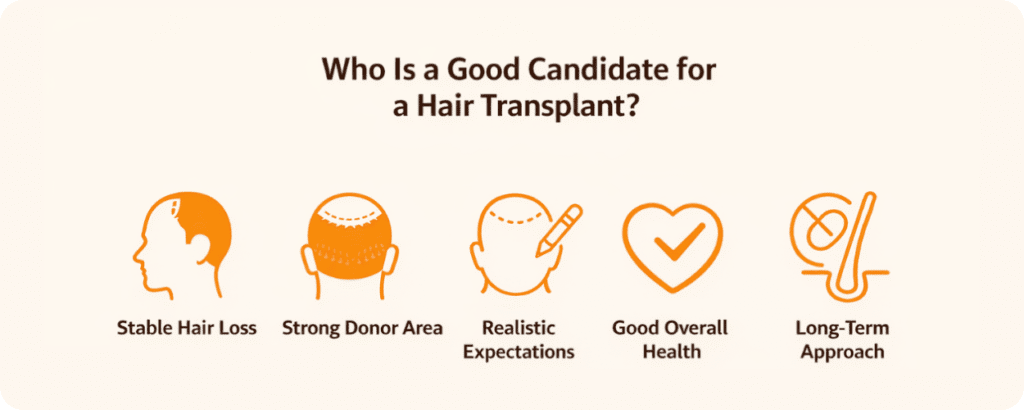
- A strong donor area
- Realistic expectations
- Skilled execution of the crown pattern
For many patients, the result is:
- Reduced visibility of the scalp
- Improved overall balance of the hair
- A more natural, fuller appearance
How Many Grafts Are Needed for a Crown Hair Transplant?
The number of grafts required for the crown varies significantly depending on the size of the area and the level of hair loss.
In general:
- 1,500–2,000 grafts may be used for smaller crown areas
- 2,500–3,500+ grafts are often required for more advanced crown thinning
Because the crown is a circular area that spreads hair in multiple directions, it typically requires more grafts than patients expect.
For this reason, clinics often prioritise:
- The hairline and frontal area first
- The crown as a secondary or staged procedure
This ensures the most visible and impactful areas are addressed before allocating large numbers of grafts to the crown.
What Affects Crown Hair Transplant Results?
Several factors influence how successful a crown hair transplant will be.
- Size of the Crown Area
Larger crown areas require more grafts to achieve visible coverage.
If grafts are spread too thinly, the result may not appear dense enough.
- Donor Area Strength
A strong donor area is essential, particularly because crown procedures can require a high number of grafts.
Donor capacity must also be preserved for potential future treatments.
- Hair Characteristics
Hair type plays a major role in how the crown looks after transplantation.
Thicker or wavy hair provides:
- Better coverage
- Increased perceived density
- Stronger visual results
- Technique and Pattern Design
Recreating the natural crown swirl is one of the most technical aspects of hair transplantation.
This requires:
- Precise angle and direction of graft placement
- Even distribution across the circular pattern
- Attention to detail throughout the procedure
- Aftercare and Patience
Crown results take longer to develop, so patience is essential.
Following proper aftercare helps ensure:
- Strong graft survival
- Consistent growth
- Optimal final results
Crown vs Hairline Transplant: What’s the Difference?
Many patients compare crown and hairline transplants when planning treatment.
Hairline Transplant
- Faster visible results
- Lower graft requirement
- Immediate impact on appearance
- Easier to create density
Crown Transplant
- Slower growth timeline
- Higher graft requirement
- More complex design
- Focus on coverage rather than density
Because of this, many treatment plans prioritise the hairline first before addressing the crown.
How Much Does a Crown Hair Transplant Cost in the UK?
Cost varies depending on the number of grafts required and the complexity of the case.
In the UK, crown hair transplant procedures typically range from:
- £3,000 to £10,000+
Factors affecting cost include:
- The number of grafts needed
- The experience of the clinical team
- The technique used (FUE vs FUT)
- The level of aftercare provided
Lower-cost options abroad may be available, but it is important to consider the full treatment journey, including consultation and follow-up care.
Final Thoughts
Crown hair transplantation is often one of the most rewarding forms of hair restoration, but it is also one of the most technically demanding. Unlike the hairline, where density and shape are the primary focus, crown restoration requires careful planning to recreate the natural swirl pattern while distributing grafts in a way that creates the appearance of balanced, natural coverage.
One of the most important things patients can understand is that crown results take time. The crown often develops more slowly than the frontal scalp, and it is not unusual for meaningful improvements to continue beyond the 12-month mark. Patients who approach the process with realistic expectations and patience are typically the most satisfied with their final results.
The success of a crown transplant is not simply determined by the number of grafts used. Donor hair quality, crown size, hair characteristics, graft placement, and long-term planning all play a significant role in the outcome. A well-executed crown transplant should reduce scalp visibility, improve overall balance, and blend naturally with the surrounding hair, rather than appearing artificially dense or obvious.
If you are considering a crown hair transplant, Capital Hair Restoration offers consultations across the UK, including Harley Street, London, Cambridge, Chelmsford, Guildford, Portsmouth, Reading, Southampton and Watford.
At Capital Hair Restoration, consultations focus on crown assessment, donor area capacity, graft planning, density expectations, future hair loss considerations, and realistic long-term outcomes. Our experienced team will explain exactly what is achievable in your case and create a personalised treatment plan designed to deliver natural, balanced results.
Book your free consultation today and take the first step towards restoring a fuller, more natural-looking crown.


Book Your Free Hair Transplant Consultation
Fill in your details and we'll get in touch with you shortly.