


How Many Grafts Do You Need for a Beard Transplant?
How Many Grafts Do You Need for a Beard Transplant?
How Many Grafts Do You Need for a Beard Transplant?
One of the first practical questions men ask when they start researching beard transplants is how many grafts they are likely to need. It is a completely reasonable question, and understanding the answer helps to set realistic expectations about what the procedure involves, how long it will take, and what results are achievable.
The honest answer is that graft numbers vary considerably from one patient to the next, and there is no single figure that applies to everyone. The number of grafts needed for your beard transplant depends on the size of the area being treated, the density you want to achieve, the characteristics of your donor hair, and the specific goals you bring to the consultation. This article explains the key factors that influence graft numbers and gives a general guide to what different beard transplant scenarios typically require.
“The number of grafts needed for a beard transplant is highly individual. The right graft count is not about maximising numbers, but about creating the right balance of coverage, density, and natural appearance.”
Darryl King, Hair Transplant Consultant, Capital Hair Restoration
What Is a Graft?
Before looking at numbers, it helps to understand exactly what a graft is and why the count matters.
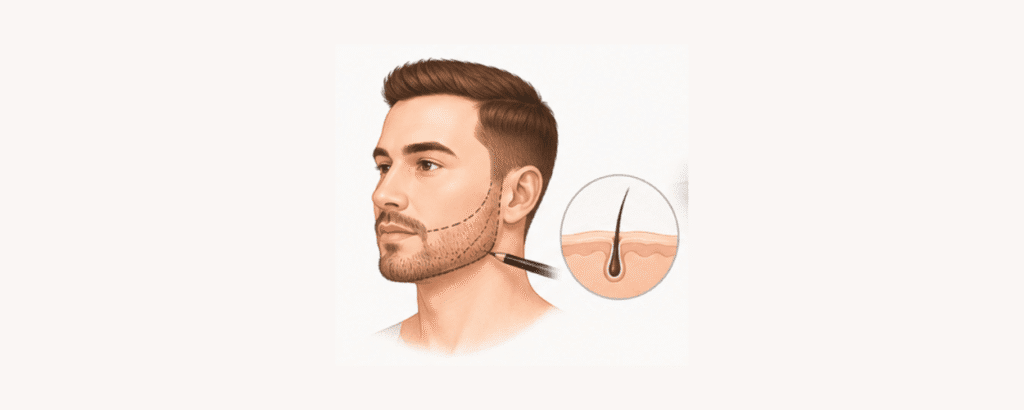
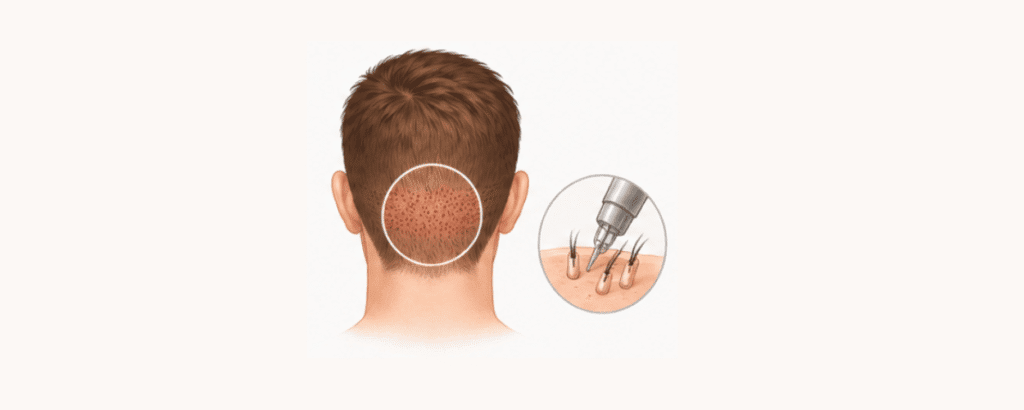
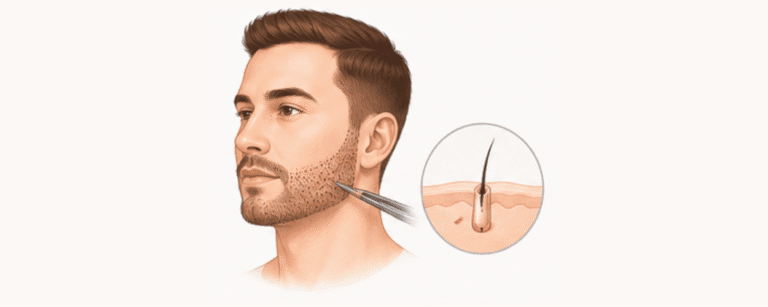
A graft, in the context of a hair transplant, refers to a follicular unit. Each follicular unit is a naturally occurring grouping of hair follicles as they exist in the skin, typically containing between one and four individual hairs. When a surgeon extracts and implants grafts, they are working with these follicular units as the basic unit of transplantation.
The number of grafts placed in a procedure determines both the coverage and the density of the result. More grafts mean more hair, but the relationship is not simply linear. The calibre and texture of the donor hair, the size of the recipient area, and the natural spacing of facial hair all affect how a given number of grafts translates into visible coverage and density.
It is also worth understanding that graft count and hair count are different things. A procedure involving 1,500 grafts may involve anywhere from 1,500 to 4,500 individual hairs, depending on how many hairs each follicular unit contains. When comparing graft estimates from different clinics, it is important to ensure you are comparing like with like, as some clinics quote hair counts rather than graft counts, which can make a procedure sound larger than it actually is.
The Key Factors That Determine Graft Numbers
Several factors influence how many grafts are needed for a beard transplant, and understanding them helps to explain why there is such a wide range in the numbers quoted for different patients.
The size of the treatment area is the most obvious factor. A full beard covering the cheeks, jawline, chin, and moustache area requires significantly more grafts than a targeted procedure addressing a specific patchy zone. The larger the area being treated, the more grafts are needed to achieve meaningful coverage across it.
The density goal is the second major factor. Some patients want a relatively natural, medium-density beard. Others want maximum density and coverage. Achieving a higher density requires more grafts per square centimetre of treatment area, which increases the total graft count needed.
The characteristics of the donor hair also play a role in determining how many grafts are needed. Men with thicker, coarser donor hair tend to achieve better visual coverage per graft than men with finer hair, because each individual hair has a greater visual impact. This means that a patient with fine donor hair may need more grafts to achieve the same visual result as a patient with coarser hair, even if the treatment area is exactly the same size.
The starting point matters too. A man with no facial hair at all needs more grafts than a man who already has some growth and simply wants to fill in gaps or add density. The existing hair contributes to the overall coverage, which means fewer transplanted grafts are needed to achieve a satisfactory result.
The condition of the recipient skin can also affect graft planning. Scar tissue, as discussed in an earlier article in this series, may support a lower density of grafts than healthy skin, which can affect the total number that can be placed in a single session.
“Patients often focus on graft numbers, but graft placement is just as important. A well-designed beard with 1,500 grafts can look far better than a poorly planned procedure using significantly more.”
Steven Ambrose, Hair Transplant Consultant, Capital Hair Restoration
General Graft Number Guidelines by Treatment Area
While every case is individual and the only accurate graft estimate comes from a proper consultation, the following general ranges give a useful indication of what different beard transplant scenarios typically involve.
A moustache transplant, targeting the upper lip area only, typically requires somewhere in the range of 300 to 600 grafts, depending on the density desired and the size of the area being covered.
A goatee transplant, covering the chin and immediate surrounding area, typically requires between 600 and 1,000 grafts for moderate density coverage.
Targeting patchy cheeks on both sides, without treating the rest of the beard, typically requires between 500 and 1,500 grafts depending on the extent of the patchiness and the density being aimed for.
A full beard transplant covering all zones of the face, including cheeks, jawline, chin, and moustache, typically requires between 1,500 and 3,500 grafts. For patients starting from nothing and aiming for a fuller result, the upper end of this range or beyond may be needed.
Sideburn restoration, targeting the sideburn area on both sides, typically requires between 200 and 600 grafts depending on the extent of the area being treated.
It is important to treat these figures as broad indicators rather than fixed estimates. The actual number recommended for your procedure will be determined by your surgeon based on a direct assessment of your face, your donor area, and your goals. A surgeon who quotes a specific number without examining you in person is not giving you a reliable estimate.

Can You Have Too Many Grafts in One Session?
This is a question that comes up regularly, and it is worth addressing directly. There is a practical limit to the number of grafts that can be safely harvested and placed in a single procedure session, and this limit is determined by several factors.
The first is the donor area. Harvesting too many follicles from the donor zone in a single session risks creating visible thinning at the donor site, which is an unacceptable outcome. The maximum number of grafts that can be safely extracted in one session depends on the density and size of the donor area and varies from patient to patient.
The second limiting factor is graft survival. There is evidence that placing a very large number of grafts in a single session can affect the survival rate of individual grafts, as the recipient sites compete for the available blood supply during the initial healing period. Most experienced surgeons set a practical upper limit per session to ensure that graft survival is maximised rather than compromised by volume.
For beard transplants specifically, the total number of grafts placed in a single session rarely exceeds 2,500 to 3,000 for most patients, though this varies depending on the individual case and the surgeon’s assessment of what can be safely achieved. For patients who need more grafts than can be safely placed in one session, a staged approach across two procedures is the responsible way to achieve the desired result.
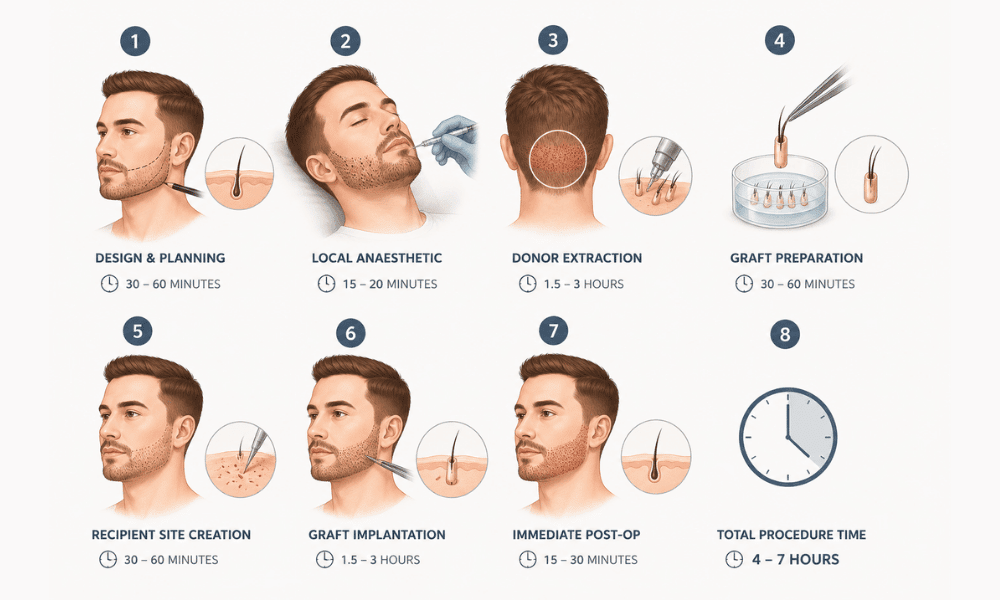
hair transplant process times
Does Graft Number Affect How Long the Procedure Takes?
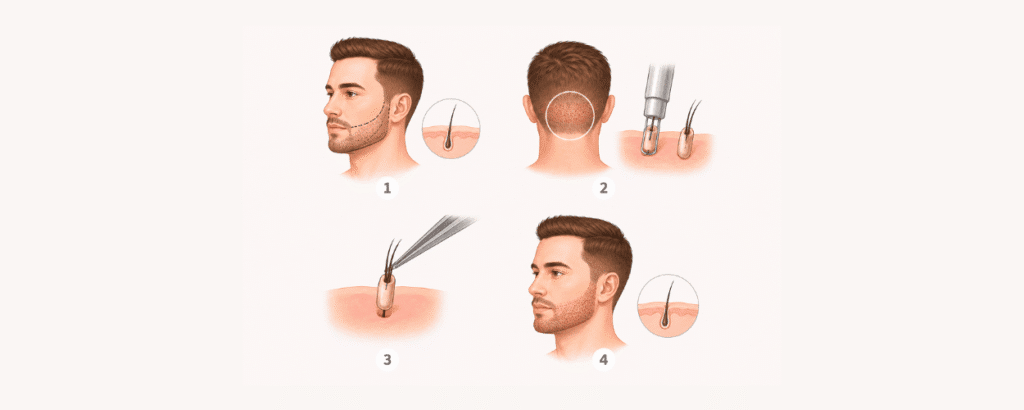
Yes, directly. The more grafts being placed, the longer the procedure takes. This is because each graft must be individually extracted, prepared, and implanted, and the care required at each stage cannot be rushed without compromising the outcome.
As a general guide, a smaller procedure involving around 500 to 800 grafts might take between three and five hours from start to finish. A mid-range procedure in the 1,000 to 1,500 graft range typically takes between five and seven hours. A larger full beard procedure involving 2,000 or more grafts can take eight hours or longer.
Patients should be prepared for the procedure to take the full day, particularly for larger graft counts. Comfort is maintained throughout with local anaesthetic, and breaks are provided as needed. Most patients find the experience more manageable than they anticipated, particularly once the anaesthetic is in place and the procedure is underway.
What Happens if You Need More Grafts Than Can Be Done in One Session?
For patients whose goals require more grafts than can be safely placed in a single procedure, a staged approach is the standard solution. This involves planning the total treatment across two sessions, with the first session addressing the most important areas and the second session, carried out after the first has fully matured, adding density or coverage to the remaining zones.
A staged approach is not a sign of a problem or a limitation in the quality of the clinic. It is simply good surgical practice that prioritises the long-term outcome over the short-term desire to get everything done at once. Rushing a larger procedure into a single session by harvesting more grafts than the donor area can safely provide, or by placing grafts at a density that exceeds what the skin can support, is a false economy that compromises both the donor site and the final result.
At Capital Hair Restoration, we plan every procedure with the patient’s long-term interests at the centre of our thinking. If a staged approach is the right way to achieve your goals, we will tell you so clearly at consultation and explain exactly what that involves.
How to Get an Accurate Graft Estimate
The only way to get a reliable graft estimate for your specific case is through a proper face-to-face consultation with an experienced surgeon. Any figure quoted online, over the phone, or based on photos alone should be treated as a rough indication at best. The factors that determine your graft count, the size and pattern of your beard growth issues, the density and characteristics of your donor hair, and the specific goals you want to achieve, can only be properly assessed through a direct examination.
At your consultation at Capital Hair Restoration, your surgeon will examine your donor area in detail, assess the beard area zone by zone, and discuss your goals with you directly. From this, they will give you a specific and personalised graft estimate that reflects what your individual case actually requires, not a generic figure based on average cases.
It is also worth asking your surgeon to explain how they have arrived at the estimate and what assumptions underpin it. A good surgeon will walk you through their reasoning clearly and answer any questions you have about the numbers. If a clinic gives you a graft count without being able to explain how they arrived at it, that is a reason to seek a second opinion.
“A consultation allows us to assess your donor area, facial hair characteristics, and goals before recommending a graft count. There is no universal number that works for every patient.”
Darryl King, Hair Transplant Consultant, Capital Hair Restoration
Why Graft Number Is Not the Only Thing That Matters
It is tempting to focus heavily on graft numbers when researching beard transplants, but it is important to remember that graft count is only one part of what determines a successful outcome. A procedure with a high graft count performed by an inexperienced surgeon can produce a poor result, while a more modest procedure performed by a skilled and experienced specialist can produce an outstanding one.
What matters most is the skill with which each individual graft is extracted, prepared, and placed. The angle, direction, and depth of every recipient site, the care taken during graft handling, the quality of the beard design, and the experience of the surgeon in replicating natural facial hair growth patterns all have a far greater impact on the final result than the raw number of grafts involved.
Graft count is a useful planning tool. It is not a measure of quality.
Book Your Beard Transplant Consultation
The number of grafts needed for a beard transplant is highly individual. While general ranges can provide a useful guide, the right graft count depends on the size of the area being treated, your desired density, the characteristics of your donor hair, and the specific result you are hoping to achieve.
It is also important to remember that a successful beard transplant is not simply about placing as many grafts as possible. The quality of the beard design, the natural distribution of the grafts, and the skill with which they are implanted all play a crucial role in determining the final outcome. A carefully planned procedure using the right number of grafts will almost always produce a better result than one focused purely on maximising numbers.
Whether you are looking to fill patchy areas, strengthen an existing beard, restore a moustache, or create a full beard from scratch, the most accurate way to determine your graft requirements is through a professional consultation. A detailed assessment allows your surgeon to evaluate your donor area, understand your goals, and create a treatment plan tailored specifically to you.
If you are considering a beard transplant, Capital Hair Restoration offers consultations across the UK, including London, Portsmouth, Reading, Watford, Cambridge, Chelmsford, Southampton and Guildford.
At Capital Hair Restoration, consultations focus on donor area assessment, graft planning, beard design, density goals, and long-term natural results. Our experienced team will provide a personalised graft estimate and explain exactly what is achievable in your individual case.
Book your consultation today and take the first step towards achieving the beard you’ve always wanted.


Book Your Free Hair Transplant Consultation
Fill in your details and we'll get in touch with you shortly.