


Where Is the Donor Hair Taken From in a Beard Transplant?
Where Is the Donor Hair Taken From in a Beard Transplant?
Where Is the Donor Hair Taken From in a Beard Transplant?
One of the questions men most commonly ask when they first start researching beard transplants is where the donor hair actually comes from. The idea of transplanting hair from one part of the body to another raises understandable questions about how it works, whether it affects the area it is taken from, and whether the transplanted hair will look and behave like natural facial hair.
This article answers all of those questions clearly and honestly, explaining where donor hair is typically sourced, why certain areas are preferred over others, and what the donor site looks like during and after recovery.
“The success of a beard transplant is not determined solely by the beard area itself. It starts with the donor area. A strong donor supply gives us the foundation to create natural-looking density and long-lasting results.”
Darryl King, Hair Transplant Consultant, Capital Hair Restoration
The Primary Donor Area: The Back and Sides of the Scalp
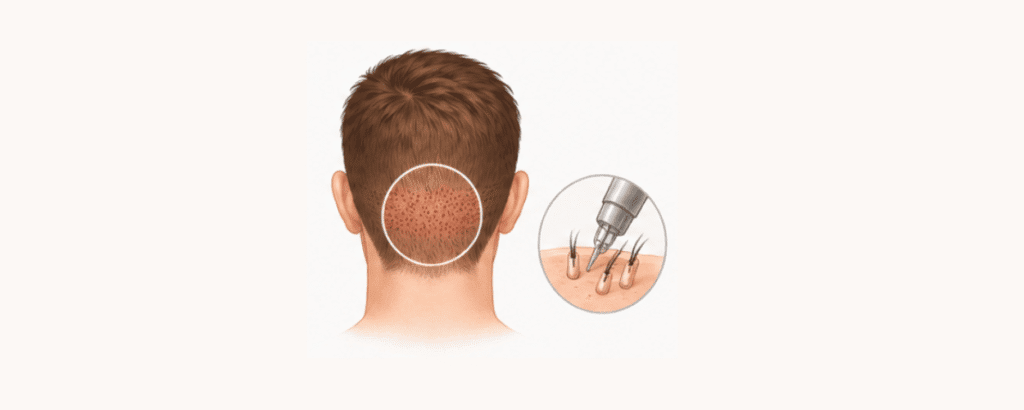
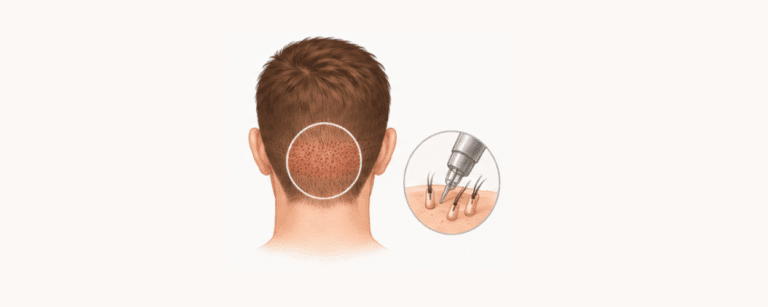
In the vast majority of beard transplants, donor hair is taken from the back and sides of the scalp. This region, often referred to as the safe zone, is the standard donor source for hair transplantation of all kinds, and for good reason.
The follicles in this area are typically resistant to the effects of dihydrotestosterone, or DHT, the hormone responsible for male pattern baldness. This resistance is a genetic characteristic of the follicles themselves rather than a result of their location. Because of this, the hair in the safe zone tends to remain stable throughout a man’s life even as hair loss progresses in other areas of the scalp.
When these DHT-resistant follicles are transplanted into the beard area, they retain their genetic characteristics. This means that once established in their new location, they continue to grow permanently and are not affected by the hormonal processes that cause male pattern baldness. The transplanted beard hair is, in this sense, inherently stable in a way that naturally occurring beard hair sometimes is not.
The safe zone typically extends across the occipital region at the back of the head and the temporal regions above and behind the ears on each side. The exact boundaries of the safe zone vary from patient to patient and are assessed carefully at consultation to ensure that donor follicles are only harvested from areas where they are genuinely stable.
Why the Scalp Is the Preferred Donor Source
The scalp is the preferred donor source for beard transplants for several reasons beyond the DHT resistance of the follicles.
Scalp hair in the safe zone tends to have characteristics that are well suited to facial use. The calibre and texture of scalp hair from this area is generally compatible with the appearance of beard hair, particularly when placed correctly by an experienced surgeon. The growth rate and growth cycle of scalp hair also tends to produce a natural-looking beard once the transplanted follicles have established themselves.
The density of follicles in the safe zone is typically higher than in other potential donor areas, which means more grafts can be harvested without creating visible thinning at the donor site. And the safe zone is easily accessible during the procedure, making the extraction process straightforward for an experienced surgical team.
“Most beard transplants use hair taken from the back and sides of the scalp because these follicles are naturally resistant to hair loss and continue growing permanently after transplantation.”
Steven Ambrose, Hair Transplant Consultant, Capital Hair Restoration
What Does the Donor Site Look Like After Extraction?
One of the most common concerns patients have about the donor area is what it will look like after the follicles have been extracted. This is a completely understandable concern, and understanding what to expect helps to put the worry into perspective.
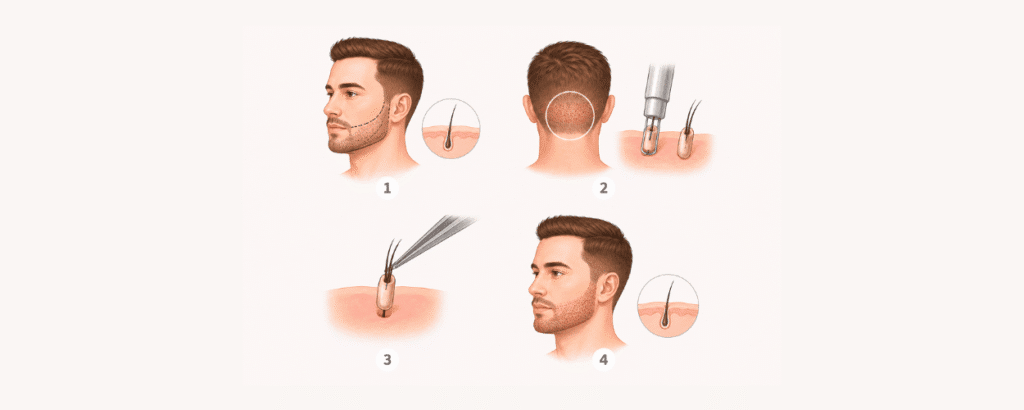
With FUE extraction, each follicle is removed through a tiny circular punch wound of around 0.8 to 1.0 millimetres in diameter. These wounds are so small that they do not require stitches. They heal naturally over the course of seven to ten days, leaving tiny white dot scars that are essentially invisible to the naked eye once the surrounding hair has grown back to its normal length.
In the days immediately after the procedure, the donor area will appear slightly red and may feel tender. The small extraction sites will be visible as tiny dots across the back and sides of the scalp. Most patients find that this settles considerably within the first week, and by around ten days post-procedure the donor area looks largely normal, with the extraction sites healed and the surrounding hair covering any residual marks.
The key to ensuring the donor area looks natural after the procedure is careful extraction technique. Distributing the extraction points evenly across the donor zone, rather than concentrating them in one small area, ensures that no single area becomes noticeably thinned. At Capital Hair Restoration, the extraction pattern is planned carefully for every patient to ensure the donor site retains a completely natural appearance both during and after the healing process.
For patients who keep their hair short at the back and sides, it is worth having a conversation with your surgeon about how the extraction pattern will be managed to ensure the donor area looks natural at your preferred hair length. This is something that is factored into the surgical plan from the outset.

How Many Follicles Can Be Safely Taken from the Donor Area?
The number of follicles that can be safely harvested from the donor area in a single session depends on the density of the safe zone, the size of the donor area, and the total number of grafts being extracted. The goal is always to take what is needed for the beard transplant without compromising the appearance of the donor site.
As a general principle, experienced surgeons work within a safe extraction ratio, taking a proportion of the available follicles from each area of the donor zone rather than exhaustively harvesting any single section. This ensures that the donor hair that remains is distributed evenly and that the overall density of the safe zone is preserved.
For most patients, the donor area can comfortably support the extraction of the grafts needed for a beard transplant without any visible impact on the scalp hair. For patients with lower donor density, or those who may also want scalp hair restoration in the future, the extraction plan needs to be more conservative and more carefully thought through. This is one of the most important conversations to have at consultation if either of these factors applies to your situation.
Body Hair as an Alternative Donor Source
For patients whose scalp donor area is insufficient to provide the number of grafts needed for their beard transplant, body hair offers an alternative source that is worth understanding. Body hair transplantation, or BHT, involves harvesting follicles from areas such as the chest, abdomen, arms, or legs and transplanting them into the beard area.
Chest hair is generally considered the most suitable body hair donor source for beard transplantation. It tends to be closer in calibre and texture to facial hair than hair from other body areas, and it is typically available in sufficient quantity to supplement a scalp donor supply that is limited but not completely absent. The extraction technique is the same FUE method used for scalp hair, with individual follicles removed one by one using a precision punch tool.
Body hair from the arms and legs can also be used in some cases, though it tends to be finer and shorter in its growth cycle than chest hair, which affects how it behaves once transplanted into the beard area. Hair from these areas may not grow as long or as consistently as scalp or chest hair, and the visual result can be less predictable.
It is important to have realistic expectations about the use of body hair as a donor source. Body hair transplantation is a more complex procedure than standard scalp donor transplantation, and the results, while meaningful for patients who have limited scalp donor supply, are typically less predictable in terms of texture, growth rate, and final appearance. Body hair is best viewed as a supplementary donor source rather than a primary one, and it is generally used in combination with whatever scalp donor hair is available rather than as a standalone solution.
At Capital Hair Restoration, the use of body hair as a donor source is discussed openly at consultation for patients where it may be relevant, with a clear and honest explanation of what it can and cannot contribute to the overall result.
Does the Donor Hair Need to Match the Beard Hair?
This is a question that comes up frequently, and it is worth addressing directly. Many men worry that hair taken from the scalp will look or behave differently to natural facial hair once transplanted, making the result look inconsistent or unnatural.
In practice, this is rarely a significant issue when the procedure is performed correctly. The key factor is not that the donor hair is identical to facial hair in its natural state, but that it is placed correctly in terms of angle, direction, and depth. When each graft is positioned to replicate the natural growth patterns of the surrounding facial hair, the transplanted hair blends seamlessly with the existing beard regardless of where it originated.
There are some cases where the characteristics of the donor hair require additional consideration. Men with very curly or coarse scalp hair, for example, may find that the transplanted hair has a slightly different texture to their natural facial hair, and this is something the surgeon will discuss with you at consultation. In most cases, however, the difference is minimal and becomes even less noticeable as the transplanted hair matures and settles into its new location.
How Is the Donor Area Assessed at Consultation?
The donor area assessment is one of the most important parts of the consultation process, and understanding what it involves helps to explain why an in-person consultation is essential before any procedure is planned.
Your surgeon will examine the back and sides of your scalp in detail, assessing the density of the follicles in the safe zone, the calibre and texture of the hair, and the overall size of the donor area available. In many cases, a trichoscope or magnification tool is used to get a more precise picture of follicle density at a microscopic level. This allows the surgeon to estimate how many grafts can be safely harvested without compromising the appearance of the donor site.
The assessment also takes into account the current and likely future state of your scalp hair. If there is evidence of active or progressing hair loss that could encroach on the safe zone over time, this is factored into the planning to ensure that the donor area is not over-committed in a way that could become problematic in the future.
For patients with body hair as a potential supplementary donor source, the relevant areas of the body may also be examined to assess whether they are suitable and what they could realistically contribute to the overall graft supply.
The outcome of the donor assessment directly shapes the surgical plan. It determines how many grafts can be placed, whether a staged approach is needed, and what results can realistically be achieved. It is one of the most important conversations of the entire process, and it is one that cannot be replicated by a photo assessment or an online consultation.
“A well-planned beard transplant should improve the beard without creating any noticeable change to the donor area. The art lies in balancing both areas carefully to achieve a natural overall result.”
Darryl King, Hair Transplant Consultant, Capital Hair Restoration
What Happens to the Donor Area Long-Term?
One of the reassuring aspects of FUE beard transplantation is that the donor area recovers well and remains natural-looking long-term for the vast majority of patients. The tiny dot scars left by FUE extraction are typically invisible once the surrounding hair has grown back, and the overall density of the donor zone is preserved when the extraction is carried out correctly.
The transplanted follicles do not grow back at the donor site once they have been extracted. However, the follicles that remain are unaffected by the extraction process and continue to grow normally. Provided the extraction has been planned and executed properly, the donor area should look no different to how it looked before the procedure once the initial healing period is complete.
For patients who are concerned about the long-term appearance of the donor area, this is something to discuss openly with your surgeon at consultation. A good surgeon will show you exactly how the extraction will be distributed, explain what the donor site will look like at different hair lengths, and give you a realistic picture of the long-term outcome before you make any decisions.
Final Thoughts
Every successful beard transplant starts with a successful donor area assessment. While most patients focus naturally on the beard itself, the quality, density, and characteristics of the donor hair play a major role in determining what can realistically be achieved and how natural the final result will look.
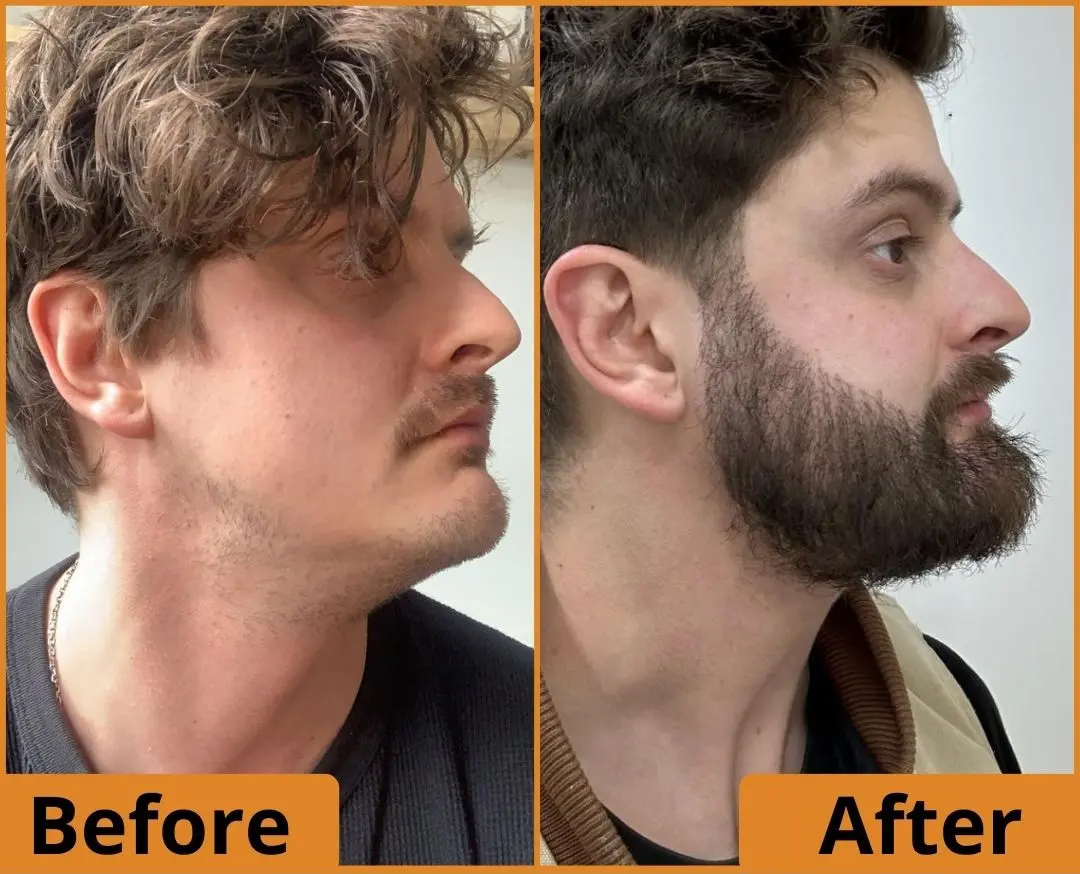
For the vast majority of patients, the back and sides of the scalp provide an excellent source of donor hair, offering follicles that are stable, permanent, and well suited to facial transplantation. When harvested and implanted correctly, these follicles integrate seamlessly into the beard, creating natural-looking growth that can be shaved, trimmed, and styled just like any other facial hair.
Understanding where donor hair comes from, how it is assessed, and what happens to the donor area after extraction can help remove much of the uncertainty that surrounds beard transplantation. It also highlights why an experienced surgeon will always consider both the donor area and the beard area together when planning treatment.
If you are considering a beard transplant, Capital Hair Restoration offers consultations across the UK, including London, Luton, Portsmouth, Brighton, Guildford, Milton Keynes, Birmingham and Watford.
At Capital Hair Restoration, consultations focus on donor area quality, graft availability, beard design, long-term planning, and realistic expectations. Our experienced team will assess your donor supply, explain your options clearly, and create a personalised treatment plan designed to achieve the most natural result possible.
Book your consultation today and take the first step towards a fuller, natural-looking beard.


Book Your Free Hair Transplant Consultation
Fill in your details and we'll get in touch with you shortly.