


When Should You Consider a Hair Transplant?
When Should You Consider a Hair Transplant?

If you are wondering when to get a hair transplant or whether now is the right time for a hair transplant, you are not alone. Many men reach a point where medical treatments are no longer enough and start asking whether a more permanent solution is the next step.
When Is the Right Time for a Hair Transplant?
The best time to get a hair transplant is when your hair loss has stabilised, medical treatments are no longer giving the desired results, and you have a strong donor area. Most men consider a transplant once thinning is established and affecting confidence, typically in their late 20s or beyond.
Hair loss is a gradual process for most men. It often starts with a slightly receding hairline, thinning at the crown, or reduced density across the scalp. At first, it may seem like a minor cosmetic issue, but over time it can affect confidence, appearance, and everyday interactions.
Research into the psychosocial impact of hair loss shows how significant this change can be. More than 70% of men report that their hair is an important part of their image, and around 62% say hair loss can affect their self-esteem.
Medical treatments such as Finasteride or Minoxidil can slow or stabilise hair loss, particularly in the early stages. However, they cannot always restore areas where hair has already disappeared. A hair transplant becomes a consideration when thinning is more established and you are looking for a long-term, natural-looking solution.
Understanding the Progression of Hair Loss
Male pattern baldness does not usually happen overnight. It follows a gradual, predictable pattern driven by genetics and hormones.
Most men first notice changes at the temples or crown, with thinning slowly spreading over time. This process is known as follicle miniaturisation, where healthy hairs become finer, shorter, and less visible until they eventually stop growing altogether.
In the early stages, medical treatments such as Finasteride or Minoxidil can often slow or stabilise the process. These treatments work best when hair follicles are still active. Once an area becomes completely bald, however, medication alone is unlikely to restore meaningful growth. At this point, surgical restoration may be the most effective option.
Hair transplant surgery does not stop the underlying cause of hair loss. Instead, it redistributes healthy, DHT-resistant follicles from the back and sides of the scalp to areas where hair has thinned or disappeared. Because these follicles are genetically resistant to baldness, they continue to grow in their new location.
A well-timed transplant, supported by a long-term plan, is what creates natural and lasting results.
Darryl King – Capital Hair Restoration – Hair Consultant
Understanding where you are in the hair loss process helps determine whether medical treatment, surgery, or a combination of both is the right next step.
Signs You May Be Ready for a Hair Transplant
Not everyone experiencing hair loss needs surgery straight away. However, the following signs often indicate that a hair transplant may be the right next step.
These are some of the most common signs you need a hair transplant and indicators that you may be ready for a long-term solution.
Your hair loss pattern is established
Hair transplant surgery works best when hair loss is relatively stable. If your hairline or crown has been thinning in the same areas for several years, it becomes easier to design a natural, long-term result.
Medical treatments are no longer enough
Finasteride and Minoxidil can be effective early on. However, once areas become visibly thin or bald, they may not restore sufficient density. A transplant is often considered when treatments can no longer deliver the desired improvement.
You have sufficient donor hair
A strong donor area, typically at the back and sides of the scalp, is essential. This is where healthy follicles are taken from to restore thinning areas.
Hair loss is affecting your confidence
Many men seek treatment when hair loss begins to impact how they feel about their appearance, whether in social situations, professional settings, or daily life.
You are looking for a long-term solution
A hair transplant offers a permanent solution using your own hair. It is often chosen by those who want lasting, natural-looking results.
Most patients come to us after several years of gradual change. They are ready for a stable, long-term improvement rather than a short-term fix.
Steve Ambrose, Capital Hair Restoration – Hair Consultant
If several of these signs apply to you, it may be the right time to explore a professional consultation and discuss whether a hair transplant is suitable.
When It May Be Too Early for a Hair Transplant
One of the most common questions we hear is “when is it too early for a hair transplant?”
While a hair transplant can provide long-term, natural-looking results, timing is important. In some cases, surgery may be recommended later, once hair loss has stabilised or a clearer pattern has developed.
These are some of the most common signs you need a hair transplant and indicators that you may be ready for a long-term solution.
You are very young with early-stage hair loss
Men in their late teens or early twenties often experience the first signs of a receding hairline. At this stage, the long-term pattern of hair loss is not always clear. Transplanting too early can lead to an unnatural appearance later, as surrounding native hair continues to thin.
Specialists usually prefer to monitor hair loss over time and use medical treatments first. This helps stabilise the condition and provides a better foundation for future surgery if it becomes necessary.
Your hair loss is still progressing rapidly
If you are noticing significant changes over short periods, such as rapid thinning across the scalp, a transplant may not yet be the best option. Surgery restores hair to specific areas, but it does not stop the underlying genetic process. Without stabilisation, you may continue losing hair around the transplanted area, creating uneven density.
In these cases, Finasteride or other treatments are often recommended to slow the progression before considering surgery.
You have not yet tried medical treatment
Many men achieve good results with non-surgical options, especially in the early stages of hair loss. Finasteride can reduce DHT levels, while Minoxidil can stimulate hair growth and improve density. Trying these treatments first can sometimes delay or reduce the need for surgery.
Donor hair may be limited
A successful transplant depends on the availability of strong donor hair. If the donor area is weak or thinning, surgery may not produce the desired results. A consultation will assess this carefully and discuss realistic options.
At Capital Hair Restoration, we never rush patients into surgery. In some cases, the best decision is to start with medical treatment and revisit the transplant discussion once hair loss has stabilised.
Darryl King – Capital Hair Restoration – Hair Consultant
Taking the time to plan properly ensures that any future transplant delivers natural, balanced, and long-lasting results.
Who Is a Good Candidate for a Hair Transplant?

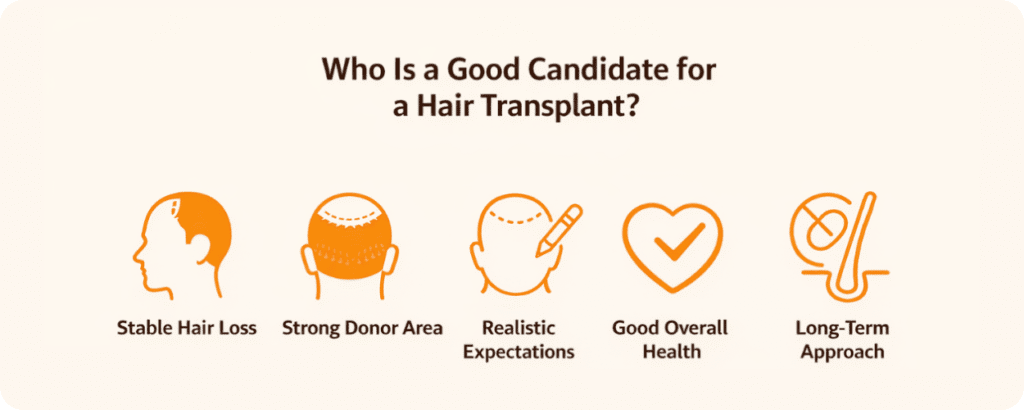
While many men consider surgery at some point, the best results are usually seen in patients who meet certain criteria. A successful hair transplant depends not only on the procedure itself, but also on the stability of hair loss, the quality of the donor area, and realistic expectations.
Stable pattern of hair loss
Men with a clearly defined pattern of male pattern baldness tend to achieve the most predictable results. When the areas of thinning are consistent and not changing rapidly, it becomes easier to design a natural-looking hairline and ensure balanced density across the scalp.
Good donor hair quality
The strength and density of the donor area play a major role in the outcome of a transplant. Healthy follicles taken from the back and sides of the scalp are resistant to DHT and continue growing after they are transplanted. Men with thicker hair, higher donor density, and good scalp health usually achieve fuller results.
Realistic expectations
A hair transplant can significantly improve appearance and confidence, but it does not recreate the hair density of adolescence. The goal is to restore a natural, age-appropriate look that blends well with existing hair. Patients who understand this tend to be the most satisfied with their results.
Good overall health
Most men are suitable for hair transplant surgery, but general health is still important. Conditions that affect healing, circulation, or scalp health may need to be addressed before surgery. A consultation helps ensure the procedure is safe and appropriate.
Commitment to long-term maintenance
Hair transplant surgery restores hair to thinning or bald areas, but it does not stop future hair loss in untreated regions. Many patients are advised to continue treatments such as Finasteride to maintain surrounding hair and protect their results over time.
The best candidates are those with stable hair loss, a strong donor area, and a clear understanding of what the procedure can achieve. With the right plan in place, results can look completely natural.
Steve Ambrose, Capital Hair Restoration – Hair Consultant
If you meet most of these criteria, a consultation with a specialist can help determine the right treatment plan and the most suitable timing for surgery.
A Typical Timeline Before Considering Surgery
Every man’s hair loss journey is different, but there is often a general progression from early thinning to the point where a hair transplant becomes the most effective solution. Understanding this timeline can help you decide when it may be the right time to consider surgery.
Understanding what stage of hair loss needs a transplant can help you decide when to move forward.
Early stage: First signs of thinning
This is when men usually notice a slightly receding hairline or thinning at the crown. Hair is still present, but it appears finer or less dense than before. At this stage, medical treatments such as Finasteride or Minoxidil are often recommended. These can slow the process and, in some cases, improve density.
Mid stage: Noticeable hairline recession or crown thinning
As hair loss progresses, the pattern becomes clearer. The temples may recede further, the crown may open up, or overall density may reduce across the scalp. Medical treatments can still play an important role, but some areas may not respond as well.
This is often the stage when men begin to seriously consider a hair transplant. The pattern of loss is more predictable, and surgery can restore density to key areas such as the hairline or crown.
Later stage: Established areas of baldness
At this stage, certain parts of the scalp may be completely bald, with little or no active follicles remaining. Medical treatments alone are unlikely to restore these areas. A hair transplant becomes the primary option for rebuilding coverage, provided the donor area is strong enough.
Planning becomes especially important at this stage. The available donor hair must be used carefully to achieve natural, long-lasting results that will still look balanced as you age.
In many cases, we see patients after several years of gradual hair loss. By that point, the pattern is clear, and we can design a transplant that looks natural both now and in the future.
Darryl King – Capital Hair Restoration – Hair Consultant
Understanding where you are in this progression helps determine whether it is the right time to move from medical management to surgical restoration.
The Importance of a Professional Consultation
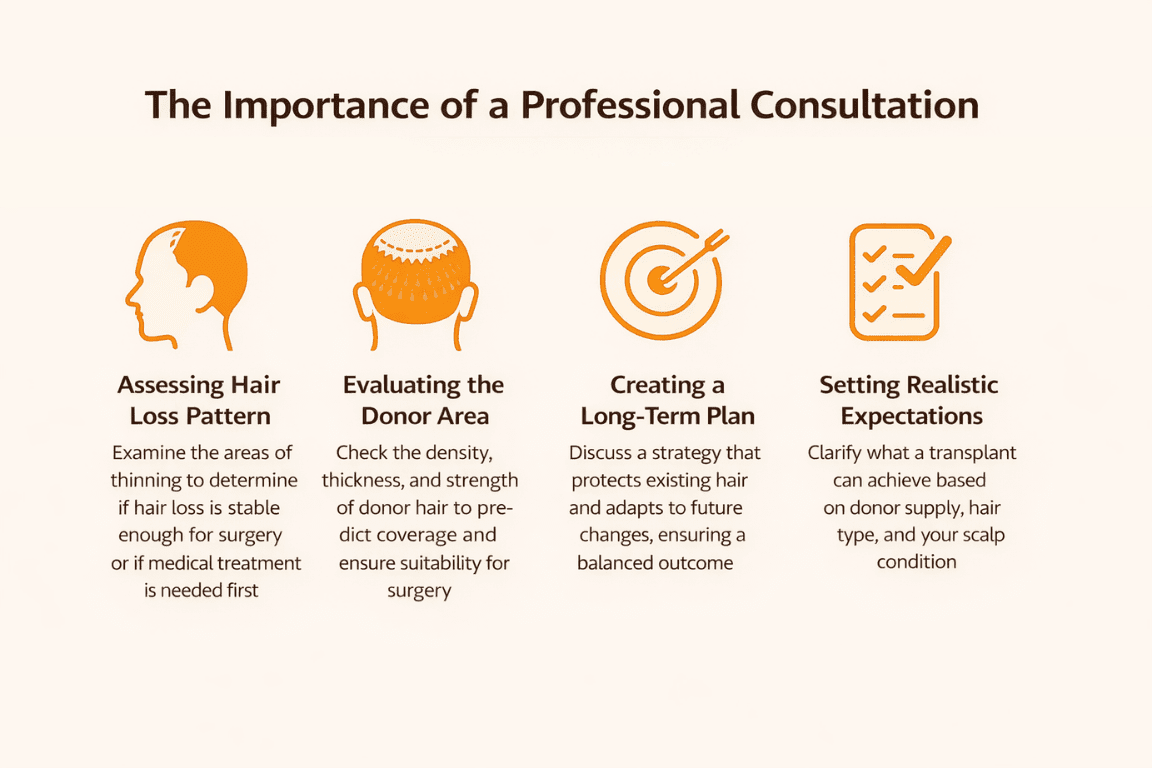
Deciding when to have a hair transplant is not something you need to work out alone. A professional consultation helps assess your hair loss pattern, donor area, and long-term goals so that any treatment is planned carefully and safely.
Assessing your hair loss pattern
During a consultation, a specialist will examine the areas of thinning and the overall pattern of hair loss. This helps determine whether the loss is stable enough for surgery or whether medical treatment should be used first to slow progression.
Evaluating the donor area
The back and sides of the scalp provide the follicles used in a hair transplant. A consultation allows the specialist to check the density, thickness, and strength of this donor hair. This is essential for predicting how much coverage can be achieved and whether surgery is suitable.
Creating a long-term plan
Hair loss is a lifelong process for many men. A responsible clinic will not only focus on the immediate result, but also on how your hair may change in the future. This may include:
- Recommending Finasteride or Minoxidil to protect existing hair
- Planning a conservative, age-appropriate hairline
- Discussing the possibility of further procedures if needed
A long-term approach helps ensure that results remain natural and balanced over time.
Setting realistic expectations
A consultation is also the time to discuss what a transplant can and cannot achieve. Factors such as donor supply, hair thickness, and scalp condition all influence the final result. Clear expectations lead to higher satisfaction and better outcomes.
At Capital Hair Restoration, the consultation is where the real planning happens. It allows us to understand the patient’s goals and create a treatment plan that will still look natural years down the line.
Steve Ambrose – Capital Hair Restoration – Hair Consultant
A proper consultation ensures that any decision to proceed with surgery is based on medical guidance, realistic expectations, and a clear long-term strategy.
Final Thoughts: Is It the Right Time for You?
A hair transplant is not just about restoring hair. It is about choosing the right moment, with the right plan, to achieve a natural and long-lasting result. For many men, the decision comes after several years of gradual thinning, when the pattern of loss is clear and medical treatments alone are no longer enough.
The best candidates are those with a stable hair loss pattern, a strong donor area, and realistic expectations about what surgery can achieve. When these factors are in place, a hair transplant can restore density, improve confidence, and provide a permanent solution using your own hair.
However, timing matters. Some men benefit from starting with medical treatment, while others may be ready for surgery sooner. The most reliable way to know is through a professional assessment.
At Capital Hair Restoration, our goal is not simply to perform surgery. It is to guide each patient toward the right decision at the right time, with a plan that will look natural both now and in the future.
Darryl King – Capital Hair Restoration – Hair Consultant
Your Next Step
If you are wondering whether now is the right time to consider a hair transplant, the best place to start is with a professional consultation. At Capital Hair Restoration, we will:
- Assess your hair loss pattern and donor area
- Explain your treatment options clearly
- Create a long-term plan tailored to your goals
- Provide honest advice on whether surgery is right for you
Your Next Step
Deciding when to have a hair transplant is often just as important as deciding whether to have one at all. While many men focus on restoring lost hair, the best long-term results are usually achieved when treatment is performed at the right stage of hair loss, with a clear strategy for the future.
At Capital Hair Restoration, every consultation is designed to determine not only whether you are suitable for a hair transplant, but whether now is the right time to proceed. In some cases, surgery may be the best next step. In others, medical treatment or a period of monitoring may provide a stronger foundation for future results.
During your consultation, we will:
- Assess your hair loss pattern and stage of progression
- Evaluate your donor area and graft availability
- Discuss medical and surgical treatment options
- Show real patient results from similar cases
- Create a personalised long-term hair restoration plan
Consultations are available across the UK, including Harley Street, London, Chelmsford, Cambridge, Guildford, Reading, Watford, Portsmouth, and Southampton.
The most successful hair transplants are rarely the earliest possible procedures. They are the treatments performed at the right time, with realistic expectations, careful donor management, and a strategy that continues to look natural for years into the future.
Book your free hair transplant consultation today and discover whether now is the right time for treatment, what results may be achievable, and how to build a long-term plan for your hair restoration journey.
Hair Transplant Timing FAQs
How do I know if I need a hair transplant?
If your hair loss is stable, medical treatments are no longer effective, and thinning areas are clearly visible, you may be a good candidate.
Is 25 too early for a hair transplant?
In many cases, yes. Hair loss patterns may not yet be stable, which can affect long-term results.
Should I try Finasteride before a hair transplant?
Yes, medical treatments are often recommended first to stabilise hair loss before considering surgery.
What stage of hair loss requires a hair transplant?
Hair transplants are typically most effective once thinning is established and areas are no longer responding to medication.
Can you have a hair transplant with thinning hair?
Yes, provided you have a strong donor area and a suitable pattern of hair loss.



Book Your Free Hair Transplant Consultation
Fill in your details and we'll get in touch with you shortly.