



Beard Transplant Recovery Timeline: Day 1 to Month 12
Beard Transplant Recovery Timeline: Day 1 to Month 12
Beard Transplant Recovery Timeline: Day 1 to Month 12
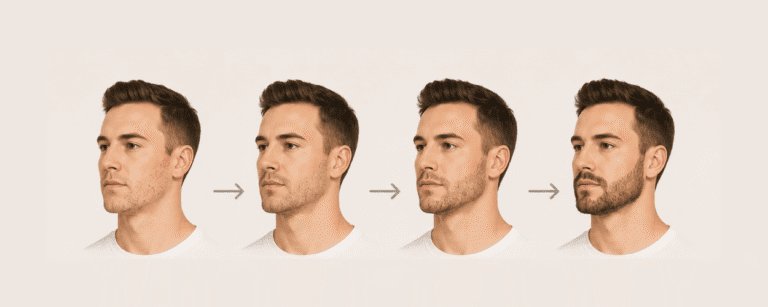
One of the most valuable things you can do before having a beard transplant is understand exactly what the recovery looks like, not just in the first few days, but across the full twelve months it takes for the final result to develop. Knowing what is normal at each stage removes the anxiety of the unexpected and helps you approach the recovery with the patience and confidence it requires.
This article takes you through the beard transplant recovery timeline in detail, from the moment the procedure ends to the point at which your final result is fully established.
Immediately After the Procedure
The moment the procedure is complete, the recovery process begins. In the hours immediately after the procedure, both the beard area and the donor site at the back of the scalp will be slightly red and tender as the local anaesthetic begins to wear off. The graft sites on the face will be visible as small raised points where each follicle has been placed, and there may be minor pinpoint bleeding around some of the sites. This is entirely normal and settles quickly.
Most patients leave the clinic on the same day as the procedure and are able to travel home, though not to drive. You will be given a comprehensive aftercare briefing and a written set of aftercare instructions before you leave, covering everything you need to do and avoid in the coming days. Following these instructions carefully is one of the most important things you can do to protect the grafts and maximise the quality of your final result.
That evening, rest is the priority. Keep your head elevated, avoid touching the graft sites, and sleep on your back with an extra pillow to reduce swelling and prevent any pressure on the treated areas. Most patients find the first evening manageable and are surprised by how settled they feel given what they have been through during the day.
“The biggest mistake patients make during beard transplant recovery is judging the result too early. The first few months are about healing and resetting the follicles, not final density.”
— Darryl King – Hair Transplant Consultant – Capital Hair Restoration
Day 1 to Day 3
The first three days after a beard transplant are the most critical in terms of graft protection. During this period, the newly transplanted follicles are not yet anchored securely in the skin and are vulnerable to being dislodged by friction, pressure, or trauma. The priority is to protect the graft sites and allow the initial healing process to begin undisturbed.
Swelling is common during the first three days and tends to peak around day two or three. The swelling can extend from the beard area down towards the neck and occasionally affects the area around the eyes. This is a normal response to the procedure and resolves on its own without treatment. Keeping the head elevated, staying well hydrated, and avoiding sodium-heavy foods can help to manage the degree of swelling.
The graft sites will feel tender during this period, and paracetamol is usually sufficient to manage the discomfort. Avoid ibuprofen and aspirin, as these can affect blood clotting and are not recommended in the early recovery period.
Day 4 to Day 7
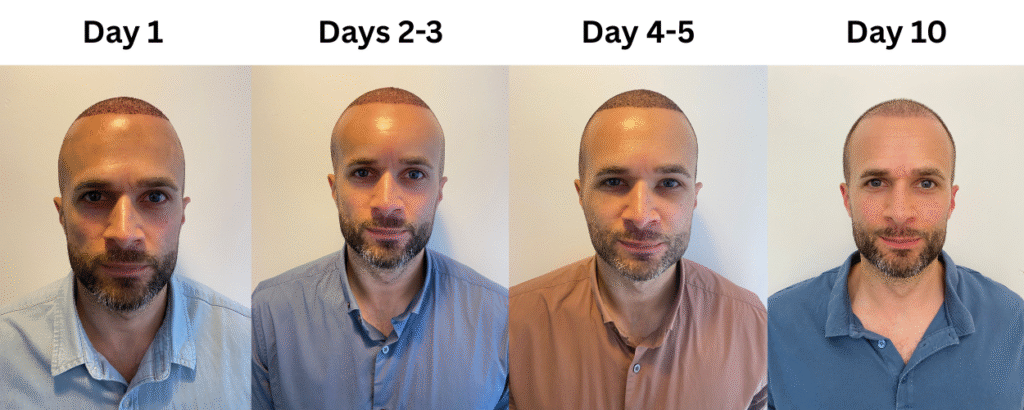
By day four, the acute phase of the recovery is beginning to ease. The swelling should be noticeably reducing, the tenderness is settling, and the small scabs that have formed around each graft site are becoming more defined. These scabs are a normal and important part of the healing process. They form as the skin repairs itself around each graft site and act as a protective layer over the follicles beneath.
The scabs should be left completely undisturbed. Do not pick, scratch, or rub them under any circumstances. Each scab sits directly over a transplanted follicle, and dislodging it prematurely risks removing the graft along with it. This is one of the most common causes of preventable graft loss in the early recovery period, and it is one that is entirely within your control.
Washing the face during this period should be done very gently using the technique provided in your aftercare instructions. Most clinics recommend a light saline spray or a gentle pouring technique rather than direct rubbing or scrubbing of the treated area. The donor area at the back of the scalp can typically be washed more normally by this stage, though care should still be taken to avoid any harsh rubbing.
Most patients who work in desk-based roles find that they are able to return to work by day four or five, provided they are comfortable doing so. The visible signs of the procedure are still present at this stage, so if your work involves close face-to-face contact or you are not comfortable with the current appearance of the treated area, waiting until the end of the first week is a reasonable approach.

Day 7 to Day 14
The end of the first week marks a significant milestone in the recovery process. For most patients, the scabs have largely cleared by day seven to ten, falling away naturally as the skin beneath heals. Once the scabs have gone, the treated areas look considerably more normal, and most patients feel comfortable in social situations without the procedure being obviously visible.
With the scabs gone, the graft sites are now more securely healed, and the restrictions on facial washing and skincare can be relaxed somewhat. Your aftercare instructions will specify when you can return to normal washing and grooming routines, and it is important to follow this guidance rather than rushing it.
The transplanted hairs are still present at this stage, sitting in the skin much as they did when they were first placed. They have not yet shed, and for some patients the beard may appear to look fuller than expected at this point. This can create a false impression of how the final result will look, and it is important to understand that the hairs you can see now are not the permanent result. The shedding phase is still to come.
Exercise should continue to be avoided during the second week. Intense physical activity raises blood pressure and causes sweating, both of which can affect the healing graft sites and increase the risk of complications. Light walking is generally acceptable, but anything more strenuous should wait until the two week mark has passed.
Weeks 2 to 4: The Shock Loss Phase
The period between two and four weeks post-procedure is one of the most important to understand before having a beard transplant, because it is the phase that catches the most patients off guard if they are not prepared for it.
From around two weeks after the procedure, the transplanted hairs begin to shed. This process, known as shock loss or effluvium, is entirely normal and is a predictable part of the hair transplant process. The hairs that were transplanted fall out as the follicles enter a resting phase before beginning to produce new growth. It does not mean the grafts have failed. The follicles themselves remain intact beneath the skin and will begin producing new hair from around the three to four month mark.
For some patients, the shedding can feel dramatic. The beard area may look thinner than it did before the procedure, and men who started with some existing facial hair may notice that even some of their pre-existing hair has shed in the treated areas. This can be unsettling, particularly for patients who were not fully prepared for it, and it is one of the most common reasons patients contact their clinic in a state of anxiety during the recovery period.
The message is simple and important: shedding is normal, expected, and does not indicate a problem. Every patient who has a beard transplant will go through this phase. The key is to trust the process, follow your aftercare instructions, and resist the temptation to draw any conclusions about the final result based on how things look at this stage.
By the end of week four, the shedding phase is typically complete for most patients. The beard area may look quite sparse at this point, and for patients who started with no facial hair, the face may look much as it did before the procedure. This is the low point of the recovery timeline in terms of visible progress, and it is the phase that requires the most patience.
“Shock loss is the stage that worries patients the most, but it is also one of the most normal parts of recovery. The follicles remain healthy beneath the skin and new growth follows afterwards.”
— Steven Ambrose – Hair Transplant Consultant – Capital Hair Restoration
Month 2: The Quiet Phase
Month two is often described by patients as the quietest and most testing part of the recovery. The shedding has completed, the follicles are in their resting phase, and there is little visible change from week to week. The procedure is done, the recovery is progressing, but there is nothing yet to show for it.
This phase is entirely normal and is not a sign that anything has gone wrong. The follicles beneath the skin are going through the natural cycle of rest before entering the active growth phase. New hair growth will begin to emerge from around the three to four month mark, but in month two there is often very little visible progress to report.
The temptation during this phase is to scrutinise the beard area daily for signs of new growth. Most patients find that this makes the waiting harder rather than easier. Checking less frequently, and trusting that the process is unfolding as it should beneath the surface, tends to make month two considerably more bearable.
Months 3 to 4: The First Signs of Growth
The three to four month mark is when the recovery timeline begins to feel genuinely rewarding. This is the point at which the transplanted follicles emerge from their resting phase and begin producing new hair growth for the first time. For many patients, seeing the first new hairs appearing is an emotional moment after the patience the preceding weeks have demanded.
The new growth at this stage is typically fine and soft, lighter in colour than the final hair will be, and distributed somewhat unevenly across the treated area. Not all follicles will emerge at exactly the same time, and the coverage may look patchy or inconsistent at first. This is entirely normal. Different follicles emerge at slightly different rates, and the overall picture continues to develop over the months that follow.
Some patients find that the new growth at this stage looks thinner or less impressive than they hoped. This is not a reflection of the final result. The hairs are still in the early stages of the growth cycle and have not yet thickened to their mature calibre. The density and coverage visible at three to four months is not the final picture, and it is important not to judge the outcome at this stage.
By the end of month four, most patients have a visible indication of where the beard is growing and what the general pattern of the result will look like. The outline of the beard design is becoming clearer, and there is enough new growth to give a sense of the direction things are heading.
Months 5 to 8: The Growth Phase
The period between months five and eight is when the most visible and exciting progress takes place. The new hairs are thickening and maturing, the coverage is becoming more even and consistent, and the beard is starting to take the shape that was planned at the consultation.
By month six, most patients are seeing meaningful density in the treated areas. The hairs have grown longer and thicker than they were at the three month mark, and the overall appearance of the beard is starting to resemble the intended result. For many patients, this is the first point at which they feel genuinely comfortable showing the beard to others and discussing what they have had done.
Month seven and eight bring further thickening and maturation. The hairs that were fine and soft at three months have now developed into proper beard hairs with the texture, strength, and growth rate of natural facial hair. The beard can be trimmed, shaped, and styled at this point, and most patients find that it behaves exactly like natural facial hair because, of course, it is.
The progress from month five to eight is often described by patients as the most satisfying phase of the entire journey. After the patience required in the early months, seeing the result come to life week by week is genuinely exciting, and most patients at this stage feel that the wait was entirely worth it.
Months 9 to 12: The Final Result
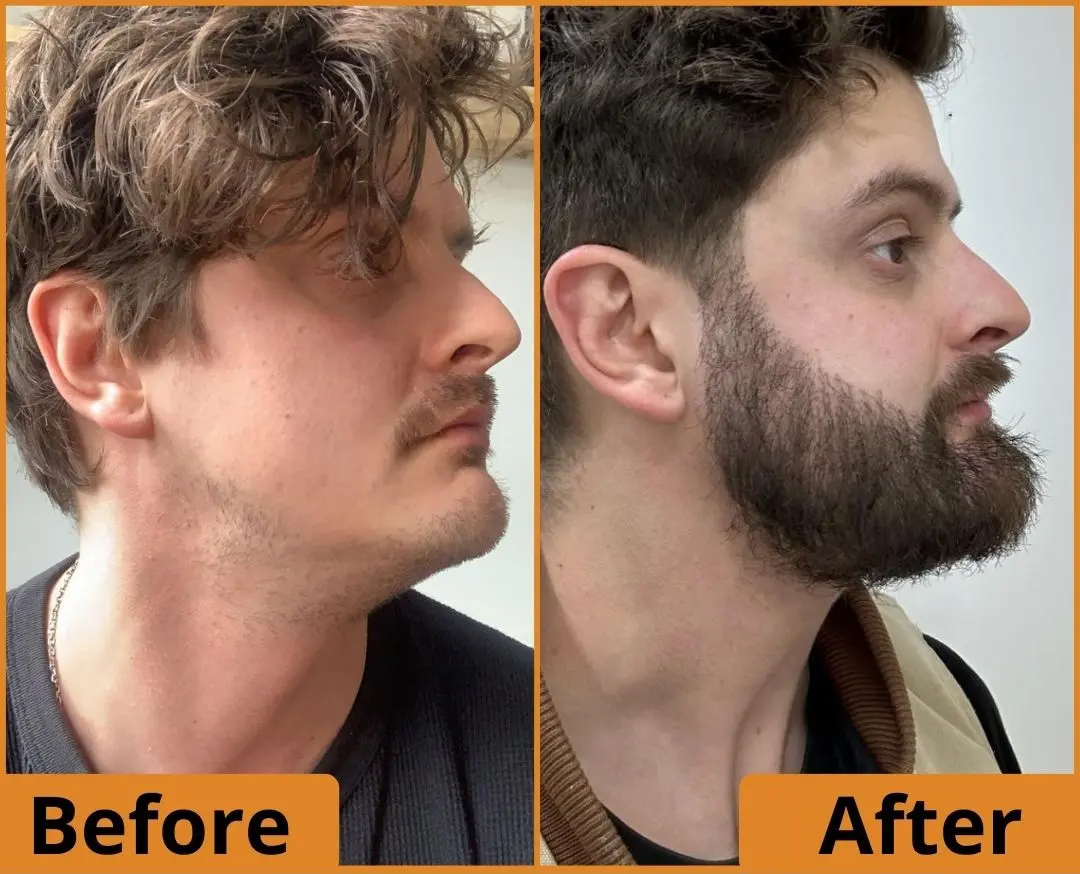
The period from month nine to month twelve is where the beard transplant result reaches its full maturity. The hairs that began growing at three to four months have now been through multiple growth cycles, and the difference in thickness, density, and overall appearance compared to the early months is striking.
By month nine, the vast majority of the transplanted follicles are producing mature hair. The beard has taken on its permanent character, with a density, texture, and growth pattern that is indistinguishable from natural facial hair. For most patients, month nine feels like a genuine arrival point, where the beard they imagined at consultation has become the beard they see in the mirror every morning.
Months ten, eleven, and twelve bring the final layer of maturation. Some follicles that were slightly slower to establish themselves continue to thicken and contribute to the overall density during this period. The beard continues to improve incrementally right up to the twelve month mark, and for some patients, particularly those with finer hair or those who had a larger procedure, meaningful improvement can continue beyond this point.
At twelve months, the result can be assessed in full. This is the appropriate moment to evaluate whether the outcome meets your expectations and whether any further treatment might be worth considering. For most patients, the twelve month result is exactly what was discussed at consultation, and no further intervention is needed or desired. For a smaller number of patients who want additional density or who had a more complex case, a second procedure can be considered and planned at this point with a complete picture of what the first procedure achieved.
The beard that has developed over the past twelve months is permanent. The transplanted follicles will continue to grow for life, behaving exactly like natural facial hair in every respect. You can shave it, grow it, trim it, and style it however you choose, and it will respond exactly as any beard would. There is no ongoing maintenance, no special products required, and nothing to do except enjoy the result.
“A beard transplant recovery timeline is measured in months, not days. Patients who understand the process beforehand usually find the experience far less stressful and much more rewarding.”
— Darryl King – Hair Transplant Consultant – Capital Hair Restoration
Are Beard Transplant Results Permanent?
Yes.
Once fully established, transplanted beard follicles continue growing permanently.
The beard behaves exactly like natural facial hair and can be:
- shaved
- trimmed
- styled
- grown long
without any special maintenance.

A Note on Patience
The single most important part of beard transplant recovery is patience.
The recovery timeline exists for a reason, and every stage serves a biological purpose.
Patients who understand the process beforehand almost always find recovery less stressful because they know what is normal and what to expect next.
Frequently Asked Questions
How long does beard transplant recovery take?
Initial healing usually takes around 7 to 14 days, while final beard growth develops over 9 to 12 months.
Is swelling normal after a beard transplant?
Yes. Mild swelling and redness are common during the first few days after surgery.
When does shock loss happen?
Shock loss usually begins between weeks two and four after the procedure.
When will my beard start growing again?
Most patients begin seeing new growth around months three to four.
Are beard transplant results permanent?
Yes. Transplanted follicles continue growing permanently once established.
Thinking About a Beard Transplant?
A beard transplant recovery timeline is measured in months rather than days. While the first few weeks focus on healing, protecting the grafts, and navigating the shock loss phase, the real transformation happens gradually as the transplanted follicles establish themselves and begin producing new permanent growth.
Understanding what is normal at each stage of recovery can make the entire process significantly less stressful. From the initial healing period and temporary shedding through to the first signs of regrowth and the final maturation of the beard, every phase plays an important role in achieving a natural-looking result.
The patients who enjoy the recovery process most are usually those who approach it with realistic expectations and patience. Beard transplant results develop steadily over time, and while progress can sometimes feel slow in the early months, the most rewarding changes often occur between months four and twelve as density, coverage, and beard maturity continue to improve.
If you are considering a beard transplant, Capital Hair Restoration offers consultations across the UK, including Brentwood, Bristol, Bromley, Chelmsford, Ipswich, Milton Keynes, Oxford and Tunbridge Wells.
At Capital Hair Restoration, patients are supported throughout every stage of recovery, from the initial consultation through to the final result. Consultations focus on beard design, donor area assessment, graft planning, recovery expectations, and long-term natural results, helping you understand exactly what is achievable in your individual case.
Book your consultation today and take the first step towards achieving the beard you’ve always wanted.


Book Your Free Hair Transplant Consultation
Fill in your details and we'll get in touch with you shortly.
Book your consultation
Blog sections



- « Previous
- 1
- …
- 6
- 7
- 8